Edge AI
Strategy
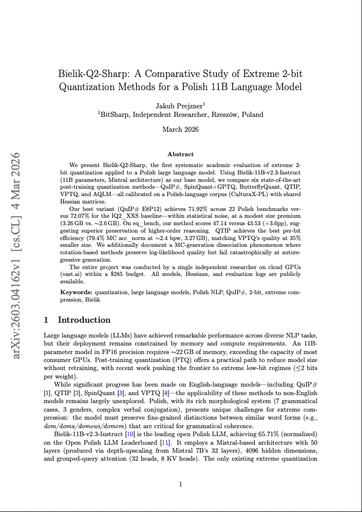
Extreme quantization (2-bit compression)
A strategy of applying advanced algorithms (e.g. QuIP#, QTIP, VPTQ) to drastically reduce the size of a model (to around 3 GB) with minimal loss of its ability to answer questions logically.
"Instead of requiring an expensive server graphics card to run a powerful Polish AI, you use a compressed version of the model that will easily fit in the RAM of an ordinary home laptop."

Strategy
Language-specific calibration
The process of fine-tuning the compressed model using only Polish texts (the CulturaX-PL corpus), to ensure that the AI does not lose the ability to understand complex Polish grammar after discarding part of its data.
"While 'slimming down' the model, you feed it a collection of exclusively Polish books and articles, so that it makes sure it still correctly declines words through cases after compression."
Strategy
Comprehensive comparison of paradigms
Strategically testing as many as six different compression technologies on a single model, to pick out the method that best preserves the advanced language abilities of a Polish AI.
"Before deploying the slimmed-down model at your company, you test it with six different compression methods (like ZIP or RAR for files), checking after which of them the artificial intelligence kept the highest IQ."
Good practice
Using cloud computing for calibration
The report demonstrates that using rented, powerful graphics cards (e.g. H200s in the cloud) cuts the time needed to prepare the model's parameters from 12 hours to just 40 minutes, which is highly cost-effective.
"Instead of tying up your computer all night to compute the model optimization, rent a cloud supercomputer for an hour for a few dollars and have the result ready by your coffee break."
Good practice
Prioritizing reasoning tests (eq_bench)
A good practice is to verify the compressed model in special, difficult tests that check deep logical inference, to make sure the model has gained in lightness without losing in intelligence.
"After shrinking the model, make it solve a complicated logic puzzle with a clever catch, rather than just asking it for the date of the Battle of Grunwald."
Good practice
Per-bit efficiency analysis
Judging the success of a model's optimization by checking how much substantive AI quality it retains relative to each megabyte of memory saved (the QTIP method wins in this comparison).
"You choose the model that, even after being reduced in size by 35%, still generates great answers, rejecting the algorithms that cut the file size but drastically dumb down the bot."
Avoid
Ignoring the "generation dissociation" phenomenon
Avoid blindly trusting the results of multiple-choice tests (A, B, C, D). A model can be great at guessing ready-made templates yet fall apart completely when writing a longer text on its own.
"Don't assume a model can write a good essay for a client just because it solved a school-style multiple-choice reading test quickly and flawlessly."
Avoid
Using rotation-based methods for generative tasks
Firmly avoid quantization techniques such as SpinQuant or ButterflyQuant if your model's main task is to continuously generate long texts – they often lead to catastrophic failures during writing.
"If you are building a customer-service chatbot for a bank, give up on the SpinQuant method so that the bot doesn't suddenly start spitting out random strings of characters mid-sentence and scare the customer."
Avoid
Ignoring local morphology when slimming down
Avoid compressing a language model intended for the Polish market using mechanisms and texts calibrated only on English, as this drastically flattens its competence in the native language.
"Don't use only American text datasets to calibrate an AI whose job will be to read and summarize for you letters from the Polish tax office."
Strategy
Dynamic resource allocation depending on difficulty (Difficulty-aware Resource Allocation)
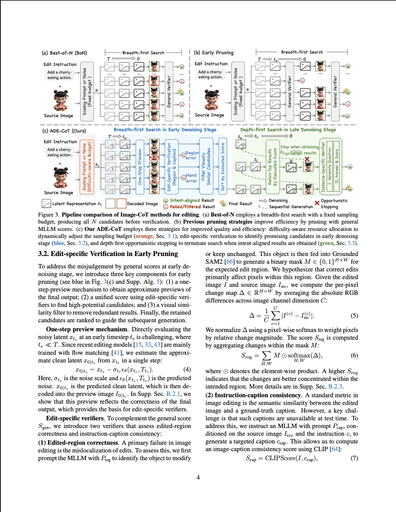
The mechanism can estimate how complicated a request to modify an image is and automatically picks an appropriate "budget" of computing time, saving it on simple tasks.
From Scale to Speed: Adaptive Test-Time Scaling for Image Editing
Strategy
Focusing verification on details (Edit-specific Verification)
In the early phase, the system rejects failed image variants by analyzing only the specific area that was supposed to change, ignoring the overall visual appeal of the whole file.
From Scale to Speed: Adaptive Test-Time Scaling for Image EditingStrategy
Opportunistic Stopping (Opportunistic Stopping)
The process intelligently halts further image generation as soon as it comes across a version that meets the given criteria, eliminating the need to excessively create dozens of variants.
"Instead of making the model mindlessly generate 50 versions of a graphic blindly, the system devotes a lot of time only to difficult cutouts (e.g. changing a forest background to a city), spot-checks the results after a few attempts and stops right away when the result is correct – saving half of the waiting time."
Good practice
Optimizing the performance-efficiency balance
Instead of relying on the traditional "generate n images and pick the best one" method (Best-of-N), it is worth using spot verification during the process.
From Scale to Speed: Adaptive Test-Time Scaling for Image EditingGood practice
Treating editing as a process with strong constraints
Remember that making corrections to photos is not the same as generating from scratch. Evaluation of the model's work should be built so that it forces the model to rigorously preserve the untouched rest of the original image.
From Scale to Speed: Adaptive Test-Time Scaling for Image EditingGood practice
Using text-visual consistency
The best indicator of a successful edit is confirming whether the small edited part of the frame perfectly matches the adjectives and nouns used in the prompt.
"Instruction for the verifying model: Analyze only the top right corner of the submitted photo of a room. Does the newly inserted object there unambiguously match the description 'old, wooden dresser'? If not, immediately reject this version."
Avoid
Blindly mapping standard Image-CoT (Text-to-Image) onto editing
Tools designed to force long chains of reasoning and generation in Text-to-Image models don't work well for modifying existing photos, causing the user's intent to be missed.
From Scale to Speed: Adaptive Test-Time Scaling for Image EditingAvoid
Fixed sampling budgets for every task
Giving every editing task the same power and number of steps is a waste of resources – a slight change of brightness doesn't need as much computation as swapping a person in the frame.
From Scale to Speed: Adaptive Test-Time Scaling for Image EditingAvoid
Judging edits with general visual scores (General MLLM scores)
Avoid using general "aesthetic scores" or broad visual ratings when rejecting early versions of an image.
"Never have the system remove variants just because the artificial intelligence model judged them 'less aesthetic', when all that was requested was a simple change of a blouse's color. Evaluate only the execution of the requested change, not the artistic composition of the whole photo."
Strategy
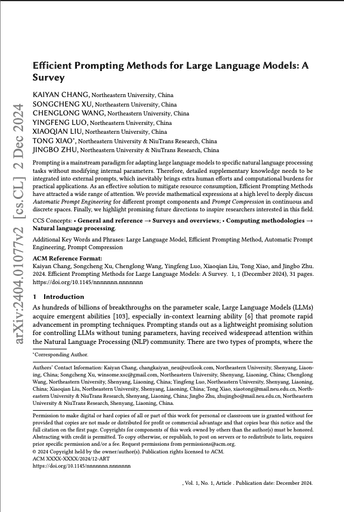
Automatic Prompt Engineering (APE)
Instead of writing and testing prompts by hand, this approach uses LLMs themselves to automatically generate and optimize instructions for different tasks. This makes it possible to achieve better results with less effort. Practical example:Explanation or prompt"Generate 5 different prompt variants that would best instruct another language model to summarize a legal text, then select and return only the one with the highest effectiveness.
Efficient Prompting Methods for Large Language Models: A Survey
Strategy
Prompt Compression
Techniques that drastically shorten long prompts by removing unnecessary words, which reduces computational cost (token usage) and speeds up response time while preserving the key information needed to solve the task. Practical example Explanation or prompt"Shorten the following 10-page project context to the 5 most important bullet points, keeping only hard facts and numbers, before you send it on to the final business analysis."
Efficient Prompting Methods for Large Language Models: A SurveyStrategy
Knowledge Distillation methods
Using the largest and most powerful models (so-called teachers) to create optimized sets of rules or patterns, which are then used to steer smaller, much cheaper models (so-called students). Practical example: Explanation or prompt"Analyze this complex dataset and, based on it, generate 3 simple, universal decision rules that a basic classification model should follow when evaluating similar tickets."
Efficient Prompting Methods for Large Language Models: A SurveyGood practice
Minimizing unnecessary context (Context Filtering)
Keeping the prompt length to the absolute minimum. Instead of pasting an entire long document, filter it and give the model only the fragments relevant to the given query, which makes the model work faster and cheaper. Practical example: Explanation or prompt"Based solely on the 'Technical Requirements' section below, list the frontend technologies used. Completely ignore and skip the information about budget and marketing."
Efficient Prompting Methods for Large Language Models: A SurveyGood practice
Separation of Instruction and Context
Good, efficient prompts have a clear structure that separates what the model is supposed to do (the instruction) from the working data it is supposed to operate on. This reduces the risk that the model treats the data as a command. Practical example:Explanation or prompt"INSTRUCTION: Translate the following text into French, keeping a formal tone. TEXT TO TRANSLATE: [Pasted text]"
Efficient Prompting Methods for Large Language Models: A SurveyGood practice
Evolution-based tuning
Iteratively improving a prompt based on the faulty outputs you receive. Instead of building the perfect prompt from scratch, start with a simple instruction and modify it, adding specific constraints wherever the AI made a mistake. Practical example:
Efficient Prompting Methods for Large Language Models: A SurveyAvoid
Prompt Inflation/Bloat
Avoid creating overly long and complicated prompts (so-called megaprompts) full of unnecessary detail for simple tasks. This drastically increases the cost of using the model API, and the extra words often just confuse it. Practical example: Explanation or prompt"You are an outstanding professor with 30 years of experience, you taught at Harvard and you love pizza. Think deeply, take a deep breath, use all of your powerful knowledge and just tell me what the formula for the area of a circle is."
Efficient Prompting Methods for Large Language Models: A SurveyAvoid
Ambiguous instructions in long context
Avoid placing your main question or command in the middle of a huge block of text. LLMs suffer from the "lost in the middle" phenomenon, so they may ignore the instruction if it is not at the very beginning or end of the query. Practical example: Explanation or prompt"Here are 20 pages of a boring annual report. Somewhere on page 10 I mention that I would like you to calculate the average profit for Q2. Read the whole thing and generate an answer."
Efficient Prompting Methods for Large Language Models: A SurveyAvoid
Ignoring token costs through excessive 'Few-Shot Prompting'
Avoid manually pasting dozens of examples of the task before you have made sure the model cannot do it with a short, well-worded instruction. Every additional example makes the query longer and costs valuable computational resources. Practical example : Explanation or prompt"[Pasting 50 bank transactions with a category added as an example] Now assign a category to this new transaction from the company XYZ." (Instead of simply using the instruction, e.g. "When assigning a category, choose from: Shopping, Fuel, Entertainment.")
Efficient Prompting Methods for Large Language Models: A SurveyDone!
You went through 27 takeaways.
Keep reading
 A Survey of Automatic Prompt Engineering: An Optimization PerspectiveBefore you talk prompts, agree on what the words mean
 The Prompt Report: A Systematic Survey of Prompt Engineering TechniquesThere's a way for AI to understand your whole text at once. And it isn't a bigger computer.
 Attention Is All You Need