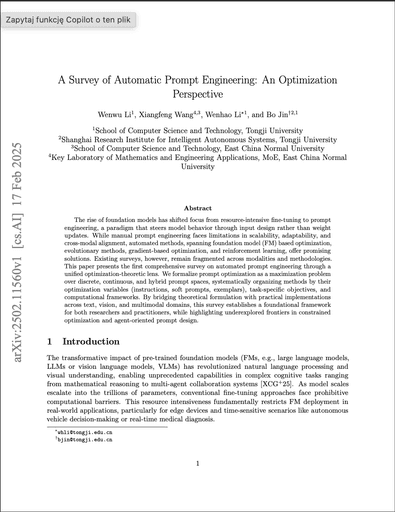
Takeaways: A Survey of Automatic Prompt Engineering: An Optimization Perspective
Strategy
Automated Prompt Optimization (APO)
A framework in which the models themselves automatically generate, test, and iteratively improve prompts, treating the process as a mathematical problem of maximizing a score instead of relying on human intuition. Explanation or promptRunning a script in which an AI generates 50 variants of a chatbot's instructions, tests each one on a set of 100 test questions, and picks the version with the highest rate of correct answers on its own.
A Survey of Automatic Prompt Engineering: An Optimization Perspective
Strategy
Evolutionary Methods
Treating prompts like organisms that can "mutate" or "cross over". The algorithm takes the best instructions from a pool and combines their fragments so that, over successive generations, an even more effective version of the text evolves. Explanation or promptThe system takes two prompts that work well: "Summarize this briefly" and "List the main points". It then "crosses" them to create a new, more effective mutation: "Briefly list 3 main points of the summary."
A Survey of Automatic Prompt Engineering: An Optimization PerspectiveStrategy
Continuous and Hybrid Prompt Spaces (Soft & Hybrid Prompts)
Tuning the model's hidden mathematical representations (vectors) instead of the natural-language words themselves. This allows deeper, more technical communication with the AI, bypassing the limits of human language.
Instead of adding more and more words to the prompt ("Be very, very nice"), the algorithm modifies, at the code level, numerical vectors attached to the user's query, which implicitly impose the right style of speech on the model.
Good practice
Defining the Optimization Objective (Task-specific Objectives)
Before you start automatic prompt engineering, you must define the objective function clearly and mathematically, that is, what exactly "success" means for the task at hand (e.g., minimizing the number of hallucinations, maximizing conciseness).
Setting a strict rule in the algorithm that tests prompts: "The optimal prompt is the one that, over 100 attempts, forces the model to generate only Python code with no side text whatsoever."
Good practice
Optimizing Example Answers (Exemplar Optimization)
Automated frameworks go beyond merely improving instructions – it is worth having algorithms search huge databases to pick the best possible "few-shot" examples to put in the prompt.
Instead of hand-picking 3 tasks for the examples section of a prompt, you let an AI model scan a database of 1,000 questions and choose the 3 most representative ones, which will teach the target model the desired logic.
Good practice
Unifying the Tooling (Unified Optimization Framework)
Moving from haphazard "guessing" of prompts in production to standardized systems that consistently evaluate instructions against the same metrics over time.
Building an automated test pipeline that every new prompt in the company must pass (verification on a fixed dataset before deployment to the application).
Avoid
Manual experimentation at large scale (Manual scalability limits)
Avoid the human, time-consuming tweaking of individual words in a prompt ("Do it well" vs "Do it precisely") when you deploy a model in a large commercial application. At this scale, human intuition is inefficient.
Hiring a team of people to guess at and test 500 versions of a query for an accounting assistant, instead of deploying an APE (Automatic Prompt Engineer) library that finds the mathematical optimum in 15 minutes.
Avoid
Focusing only on changing words (Ignoring soft spaces)
Avoid relying solely on discrete text instructions (hard prompts) if you have the computing resources and access to the model's weights to use far more powerful vector prompts (soft tuning/prefix tuning).
Writing a 5-page text file of instructions, which eats up your precious token limit, instead of training a lightweight "soft prompt" module that applies the same set of behaviors to the model as a small vector add-on.
Avoid
Aimless optimization in agent mode (Unconstrained agent design)
Be careful about using automatic prompt optimization without imposing strict safety constraints. Self-modifying prompts can evolve in ways that go against human intent.
Leaving the optimization algorithm a free hand, which can lead the system to invent a jailbreak-style prompt that carries out the task perfectly but breaks the company's data-privacy safeguards.
Done!
You went through 9 takeaways.
Keep reading
 Efficient Prompting Methods for Large Language Models: A SurveySometimes the best example is no example at all
 A Systematic Survey of Prompt Engineering in Large Language Models: Techniques and ApplicationsBefore you talk prompts, agree on what the words mean
 The Prompt Report: A Systematic Survey of Prompt Engineering Techniques