Takeaways: Attention Is All You Need
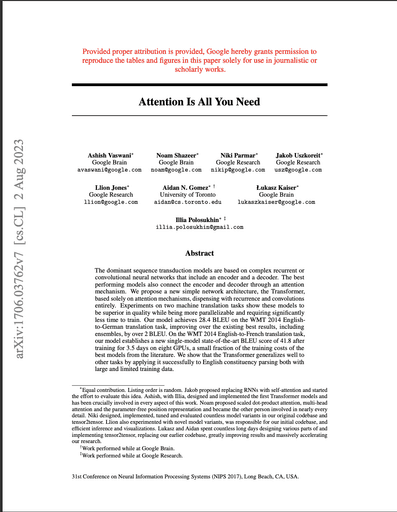
Story · 7 cards
There's a way for AI to understand your whole text at once. And it isn't a bigger computer.
It's one idea from 2017: stop reading in order. Once you see how it works, you'll write prompts the model gets right away.
Attention Is All You Need
ImagineStory 1/7
Imagine a translator wearing blinkers.
They read word by word. They can't look ahead until they've finished the word before. That's how models worked before 2017. The authors call it what it is: a sequential nature that blocks parallel work.
Source: Introduction
Attention Is All You NeedFrom the paperStory 2/7
The fix wasn't reading faster.
It was not reading in order at all. Jakob Uszkoreit proposed self-attention: every word looks at all the others at once. The order of the eight authors on the cover? Random. The contributions were equal.
Source: Author footnote
Attention Is All You NeedFrom the paperStory 3/7
One pair of eyes isn't enough. The model has eight.
Each of its 6 layers runs 8 attention "heads" at once. Nobody assigned them jobs. They split the work on their own: one follows sentence structure, another long-distance links.
Source: Sec. 3.1–3.2, Fig. 5
Attention Is All You NeedImagineStory 4/7
Imagine a sentence with the word "its".
"The Law will never be perfect, but its application should be just." You know right away that "its" means the Law. So does the model. Two attention heads learned this with no instructions, and their attention on "its" is, in the authors' words, very sharp.
Source: Fig. 4
Attention Is All You NeedFrom the paperStory 5/7
Usually you pay for quality with time. Here it went the other way.
The base version broke the record after 12 hours of training on 8 GPUs. The big one beat the best previous models by more than 2 BLEU points on German translation. On French — at less than 1/4 of the previous leader's cost.
Source: Sec. 5.2, 6.1, Table 2
Attention Is All You NeedFrom the paperStory 6/7
They built a translator. They got something more.
The same model, with no task-specific tuning, parsed sentences better than almost every earlier model built only for that: 92.7 F1. The authors admitted it did surprisingly well. It was the first sign this architecture would work for everything.
Source: Sec. 6.3, Table 4
Attention Is All You NeedImagineStory 7/7
You don't need to write less. You need to write clearer.
Imagine pasting a long report and asking about a number on page one. The model doesn't scroll through it like tape — it looks at everything at once. Your job is to point: name the section, name the thing.
Source: Based on Sec. 3–4
Attention Is All You NeedStrategy
The Self-Attention mechanism
The architecture lets the model analyze an entire sequence (e.g. a sentence) at once and judge which words are most strongly related to one another, regardless of the distance between them in the text. This replaces line-by-line analysis.
Analyze the text below and connect effects to causes. The AI's attention mechanism will automatically find the link between the profit mentioned in the first paragraph and the cost cutting in the last paragraph.
Strategy
Dropping sequential processing in favor of Parallelization
Instead of analyzing words one after another, the model processes huge blocks of text at the same time. This makes language processing drastically faster and more efficient.
Instead of "reading" a book page by page to find a mention of a particular character, the model analyzes all the pages at once, instantly connecting facts.
Strategy
Understanding broad global context
Transformer-based models can keep coherence and meaning across long conversations by assigning mathematical weight to individual keywords, so they don't lose the main thread.
"Summarize this 20-page technical document, focusing only on the system requirements for the servers."
Good practice
Providing rich and precise context
Because the model's operation is based on "attention," the better and more detailed the context you give it, the more accurately it will connect information and generate a substantive answer.
"Write an official email to a client apologizing for yesterday's delay in delivering the batch of 100 laptops. Mention a 15% discount on the next order in view of our long business relationship."
Good practice
Emphasizing key instructions (Positioning attention)
Models pay the most "attention" to keywords at the beginning or the end of a message. Placing the most important rules in those spots helps the model stick to the guidelines.
"IMPORTANT: Return the result only as a table. [Long text with the company's financial data]. Remember, the output format is only a table."
Good practice
Using the model's ability to connect distant facts (Cross-referencing)
Construct prompts so that they let the artificial intelligence look for unconventional connections in complex, long input texts.
"Here are my test results from 2018, 2020 and 2023. Put them side by side and point out which three parameters worsened the most over those 5 years."
Avoid
Stuffing the prompt with irrelevant information (Information noise)
Adding unnecessary paragraphs or details that are not relevant to the task makes the model's attention needlessly scatter, worsening the result.
Pasting 15 pages on the history of a corporation's founding, the founders' biographies and a description of the office, only to ask at the very end, "What was this company's revenue last year?".
Avoid
Expecting "human memory" beyond the context window
A model based on the Transformer architecture relies on the information contained in its current view of memory. It will not correctly refer to threads you don't remind it of within the given task.
"Write a continuation of this story, keeping the style of the one you generated for me yesterday in another chat."
Avoid
Giving contradictory or mutually exclusive instructions
The weighting mechanism evaluates all fragments of the text. Contradictory commands force it to guess your intent and lower the logical quality of the answer.
"Describe this in extreme detail, using professional legal jargon, but phrase it so that a preschooler can understand it in just two sentences."
Done!
You went through 10 takeaways.
Keep reading
 Verbalizable Representations Form a Global Workspace in Language ModelsWho should write your prompts? Maybe the model itself.
 Efficient Prompting Methods for Large Language Models: A SurveyA Polish 11B model in about 3 GB. Yes, it can shrink that far.
 Bielik-Q2-Sharp: A Comparative Study of Extreme 2-bit Quantization Methods for a Polish 11B Language Model