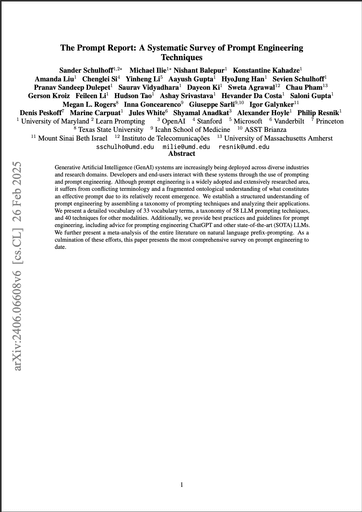
Takeaways: The Prompt Report: A Systematic Survey of Prompt Engineering Techniques
Strategy
Glossary of terms
— Contains 33 defined terms that bring order to previously inconsistent naming and make communication between researchers and practitioners easier.
The Prompt Report: A Systematic Survey of Prompt Engineering Techniques
Strategy
Meta-analysis of prefix-prompting
— A systematic summary of research findings on natural prefix-prompting, indicating which methods have repeatable effects.
The Prompt Report: A Systematic Survey of Prompt Engineering TechniquesStrategy
Practical applications
— A discussion of how prompting techniques perform in tasks such as text generation, information extraction, classification, and in multimodal systems.
The Prompt Report: A Systematic Survey of Prompt Engineering TechniquesStrategy
Evaluating effectiveness
— The report compares techniques in terms of accuracy, stability and computational cost, pointing out the trade-offs between the simplicity of a prompt and the quality of results.Best practices
The Prompt Report: A Systematic Survey of Prompt Engineering TechniquesStrategy
Precise model versioning
Always give the full version identifier (e.g. gpt-4-0613 instead of GPT-4). This prevents problems caused by models being updated in the background.
The Prompt Report: A Systematic Survey of Prompt Engineering TechniquesStrategy
Publishing full texts and templates
Share prompts in their raw form together with clearly marked variables (placeholders), so that other researchers can reproduce the experiment exactly.
The Prompt Report: A Systematic Survey of Prompt Engineering TechniquesStrategy
Defining determinism parameters
Explicitly stating the values of temperature, top-p and seed (where available) is essential for keeping results replicable in production environments.
The Prompt Report: A Systematic Survey of Prompt Engineering TechniquesStrategy
Documenting Few-shot strategies
If you use examples in the prompt, describe the criteria for choosing them (e.g. whether they were picked at random or by a specific semantic-similarity key).
The Prompt Report: A Systematic Survey of Prompt Engineering TechniquesStrategy
Reporting the date and infrastructure
Because of the model drift phenomenon, it is crucial to record the date the tests were run and the wrappers (e.g. LangChain, Guidance) or API libraries used.
The Prompt Report: A Systematic Survey of Prompt Engineering TechniquesAvoid
Using generic names
Avoid terms like “Llama” or “Claude” without specifying the model's version and size (e.g. 70B). Such data is useless for scientific and technical purposes.
The Prompt Report: A Systematic Survey of Prompt Engineering TechniquesAvoid
Relying on default settings
Never assume that the “default temperature” is constant across API versions. Not defining parameters explicitly is the most common cause of replication problems.
The Prompt Report: A Systematic Survey of Prompt Engineering TechniquesAvoid
Hiding manual post-production
If the model's outputs were manually “cleaned” or corrected before analysis, failing to mention this in the report is a methodological error.
The Prompt Report: A Systematic Survey of Prompt Engineering TechniquesAvoid
Ignoring negative results and hallucinations
Leaving out cases where the model failed makes a reliable assessment of the risk of deploying a given prompt impossible.
The Prompt Report: A Systematic Survey of Prompt Engineering TechniquesAvoid
A “magical” approach to Prompt Engineering
Avoid introducing modifications (e.g. adding “Think step by step”) without evidence that they actually improve performance in the given use case.
The Prompt Report: A Systematic Survey of Prompt Engineering TechniquesDone!
You went through 14 takeaways.
Keep reading
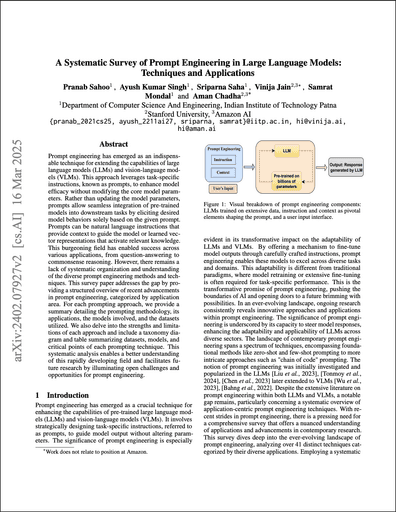
 A Systematic Survey of Prompt Engineering in Large Language Models: Techniques and ApplicationsDon't ask AI for the whole app at once
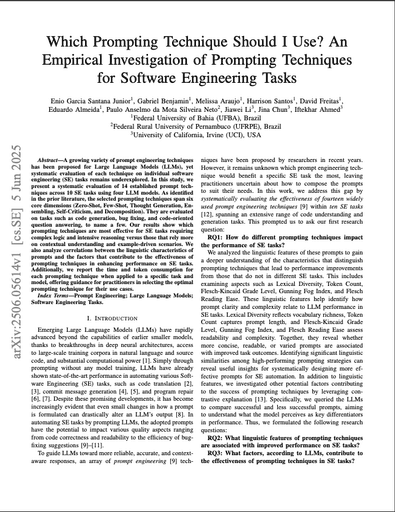
 Which Prompting Technique Should I Use? An Empirical Investigation of Prompting Techniques for Software Engineering TasksThere's a way to stop AI making mistakes in simple math. And it isn't retraining the model.
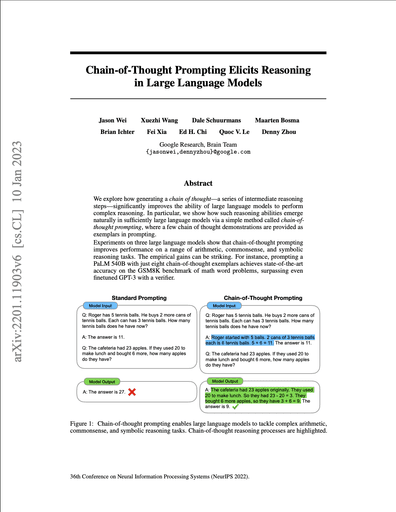
 Chain-of-Thought Prompting Elicits Reasoning in Large Language Models