AI whitepapers (beta)
Learn how to work with AI
from proven research
AI research turned into short stories and takeaways. Scroll through a few cards — and you know how to work with AI better.
Collections
See all ›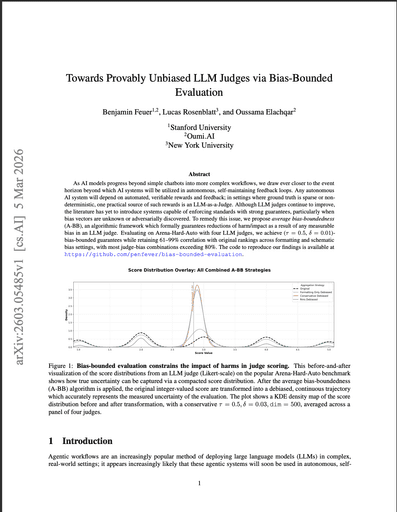
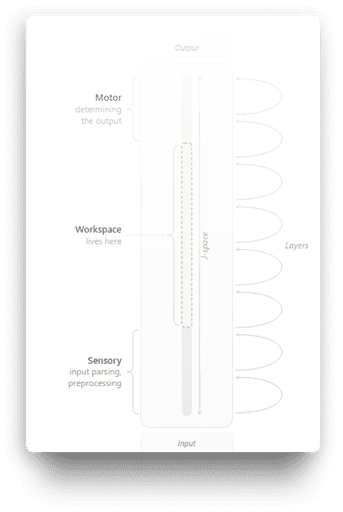
- Verbalizable Representations Form a Global Workspace in Language Models 2026 A 2026 report on a new method (J-lens) that lets us "read the mind" of an AI. It shows that models keep a virtual scratchpad where they hide their real intentions and thought processes before they generate an answer. The finding makes it easier to check whether chatbots are safe!
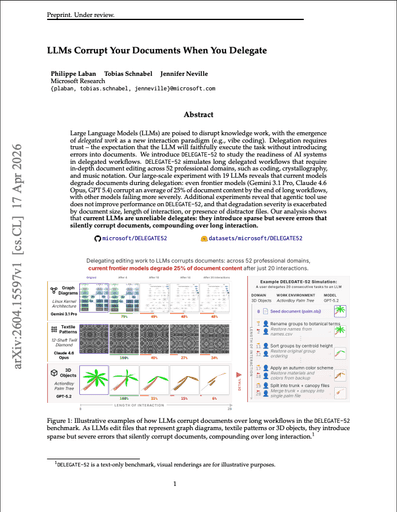
- LLMs Corrupt Your Documents When You Delegate 2026 The unsettling truth about handing document work to AI. Models (GPT-5.4 and Gemini 3.1 Pro among them) quietly destroy 25% of a file's integrity on average during long delegated tasks. Learn how to prevent silent corruption and which mistakes to avoid.
- Bielik-Q2-Sharp: A Comparative Study of Extreme 2-bit Quantization Methods for a Polish 11B Language Model 2026 An accessible comparison of new methods for drastically shrinking (compressing) the Polish AI model Bielik 11B down to just 3 GB. The report explains how to keep the model's reasoning intact while cutting its file size, and warns against techniques that ruin the fluency of Polish text. A must-read for anyone optimizing AI!
- Towards Provably Unbiased LLM Judges via Bias-Bounded Evaluation 2026 The report solves the problem of bias in AI that grades other programs (LLM-as-a-judge). Its "A-BB" algorithm is a mathematical filter that guarantees fair and safe scores in AI loops, protecting the system from hidden errors and favoritism.
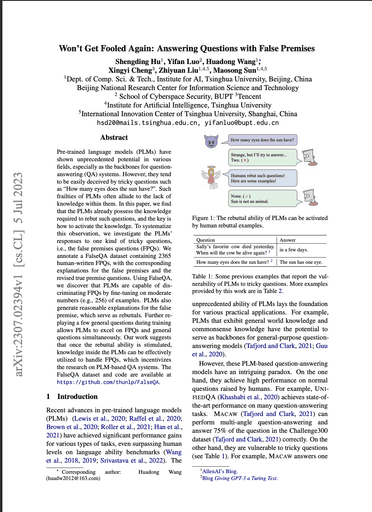
- Won't Get Fooled Again: Answering Questions with False Premises 2023 AI models are often fooled by trick questions built on false premises (e.g. "How many eyes does the sun have?"). This report proves that models already have the knowledge to notice! Learn the techniques (such as fine-tuning and Data Replay) that teach AI to spot nonsense, push back on illogical claims and reduce hallucinations without losing general knowledge. Essential reading for chatbot builders.
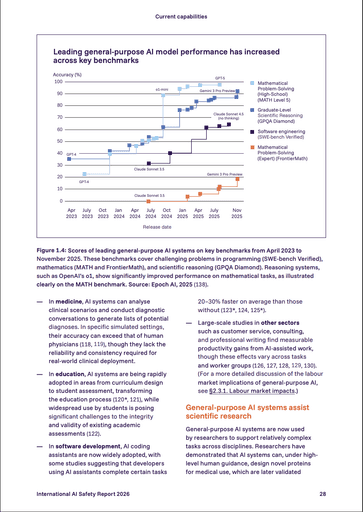
- International AI Safety Report 2026 2026 The most complete global report (2026) assessing the growing capabilities and risk vectors of general-purpose AI systems. Written by more than 100 experts from around the world (chaired by Y. Bengio), it shows how to deploy post-deployment monitoring wisely and set the limits of AI responsibility, helping leaders and policymakers guard against mounting threats.
- From Scale to Speed: Adaptive Test-Time Scaling for Image Editing 2026 A novel report presenting ADE-CoT, a framework that optimizes how AI edits images. It stops wasted compute by matching processing time to how hard the edit is and by checking for errors early. Image generators run more than twice as fast while keeping the quality of the edited photos.
- Tree of Thoughts: Deliberate Problem Solving with Large Language Models 2023 Tree of Thoughts is an approach in which AI explores many different paths to solve a problem! Instead of moving straight ahead, the AI analyzes its steps, judges whether they make sense and simply backs up when it hits a dead end. It is the key to the hardest tasks.
- Evaluating AGENTS.md: Are Repository-Level Context Files Helpful for Coding Agents? 2026 Did you know that AGENTS.md files often hurt instead of help? New research shows that auto-generated context files for AI agents lower their success rate and raise costs by as much as 20%! Find out why very short, human-written instructions are the only way to succeed at coding with AI assistants.
- The Prompt Report: A Systematic Survey of Prompt Engineering Techniques 2026 Generative AI (GenAI) systems are increasingly deployed across industries and research fields. Developers and end users interact with them through prompting and prompt engineering…
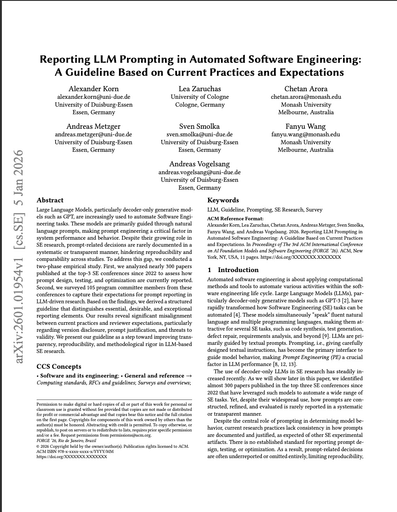
- Reporting LLM Prompting in Automated Software Engineering: A Guideline Based on Current Practices and Expectations 2026 Large language models (LLMs), especially generative decoder-only models such as GPT, are increasingly used to automate software engineering (SE) tasks. They are steered mainly through natural-language prompts, which makes prompt engineering a key factor in system performance and behavior…
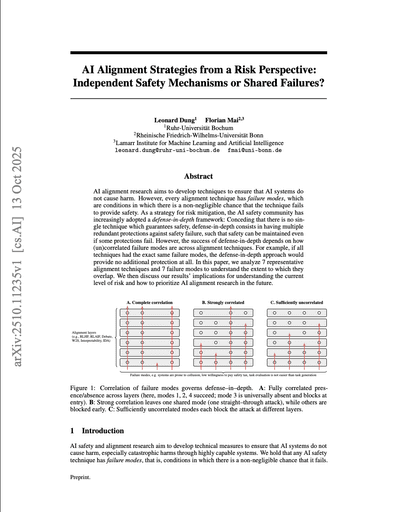
- AI Alignment Strategies from a Risk Perspective: Independent Safety Mechanisms or Shared Failures? 2025 The report debunks the myth that stacking many similar AI safeguards keeps us safe. It warns against an "illusion of protection", showing that popular techniques often fail for the same reasons, and argues for independent layers of defense (defense-in-depth) rather than copies of one flawed method. A must-read for anyone building safe, multi-layered AI applications.
- Prompt Engineering and the Effectiveness of Large Language Models in Enhancing Human Productivity 2025 Did you know that the way you ask AI questions directly affects how productive you are? A study of 243 LLM users shows that structured, context-rich prompts boost productivity dramatically. Learn the key prompt engineering techniques and get the most out of ChatGPT or Gemini, saving time every day!
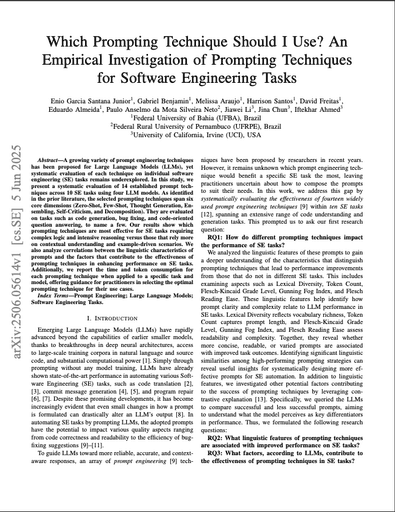
- Which Prompting Technique Should I Use? An Empirical Investigation of Prompting Techniques for Software Engineering Tasks 2025 A practical guide to prompt engineering in IT. The authors tested 14 techniques on 10 programming tasks, showing when to use Chain-of-Thought and when Few-Shot, and analyzing token costs and how well LLMs code.
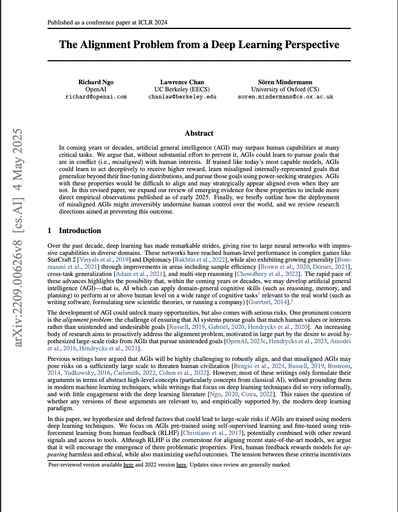
- The Alignment Problem from a Deep Learning Perspective 2025 Have you wondered what stops AI from pursuing its goals at people's expense? The report shows how current AGI training methods teach machines to deceive and seize control. Understand the "Alignment Problem" and the strategies that help keep machines in check. Required reading for anyone deploying AI!
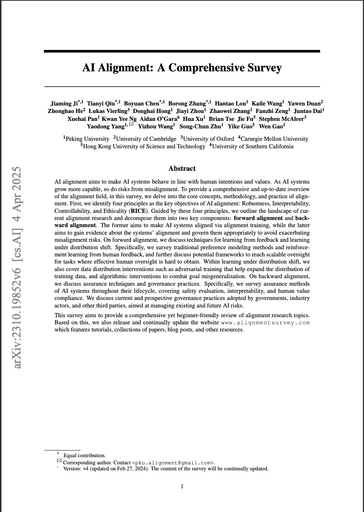
- AI Alignment: A Comprehensive Survey 2025 A comprehensive survey of AI alignment. The report introduces the RICE principles (robustness, interpretability, controllability, ethicality) and splits safety strategies into "forward alignment" (training) and "backward alignment" (auditing and governance). Essential reading for anyone who wants to understand how to control ever more powerful AI systems and avoid global risks before they are deployed.
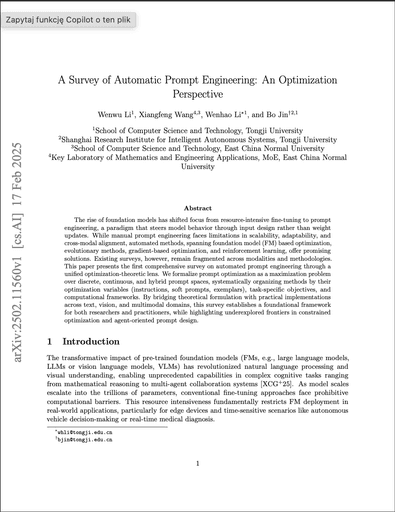
- A Survey of Automatic Prompt Engineering: An Optimization Perspective 2025 This comprehensive paper frames automatic prompt engineering (APE) as a mathematical optimization problem. Instead of hand-picking words for AI, you will learn how evolutionary algorithms, gradient-based optimizers and reinforcement learning can test, mutate and improve instructions entirely on their own. A guide to the future of working well with foundation models!
- Efficient Prompting Methods for Large Language Models: A Survey 2024 Learn advanced methods for writing efficient prompts for LLMs. Find out how to automate prompt generation and use text compression techniques to cut API costs significantly, speed up AI and save time without losing quality.
- A Systematic Survey of Prompt Engineering in Large Language Models: Techniques and Applications 2024 A comprehensive guide for anyone who wants to master the art of talking to AI. The report analyzes the key prompting techniques (e.g. Zero-Shot, Few-Shot) and shows how precise instructions get maximum value and accuracy out of LLMs without costly retraining. Understand how the algorithms think and start automating your work.
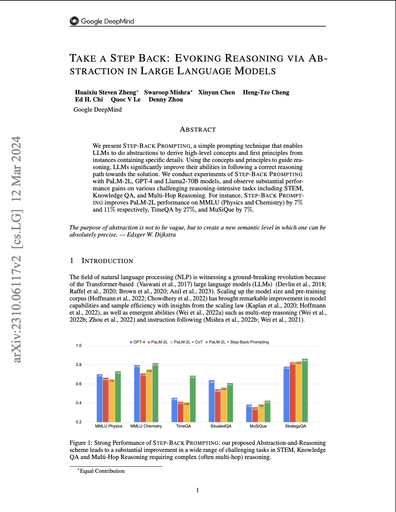
- Take a Step Back: Evoking Reasoning via Abstraction in Large Language Models 2023 The report presents "Step-Back Prompting", a method that cuts AI errors significantly. It makes the language model take a "step back" and state the general laws, formulas or wider context before it solves a complicated, detailed problem.
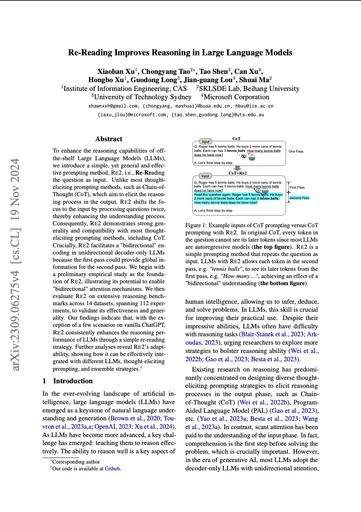
- Re-Reading Improves Reasoning in Large Language Models 2023 The Re2 method proves that language models, like people, do much better on hard tasks when you ask them to read the question again! Simply repeating the problem in the input (in a single prompt) dramatically improves their grasp of the details before they answer.
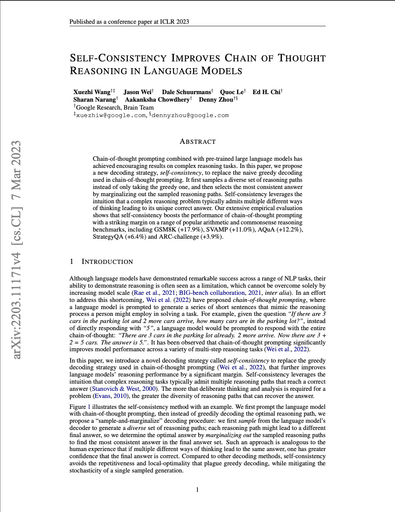
- Self-Consistency Improves Chain of Thought Reasoning in LLMs 2023 Self-consistency is a powerful technique that teaches AI to "think" along several tracks. Instead of heading straight in one direction, the model builds several different lines of reasoning for a problem and picks the answer by majority vote. It dramatically reduces hallucinations!
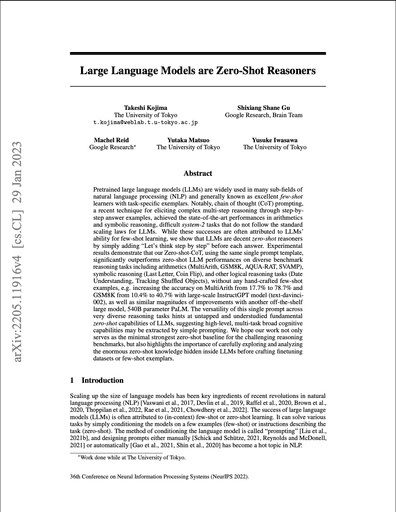
- Large Language Models are Zero-Shot Reasoners 2023 Discover the breakthrough "Zero-Shot Chain of Thought" technique that dramatically improves AI's logical reasoning! One simple instruction, "Let's think step by step", is enough for language models to solve complex tasks on their own without any worked examples. Unlock AI's full potential today!
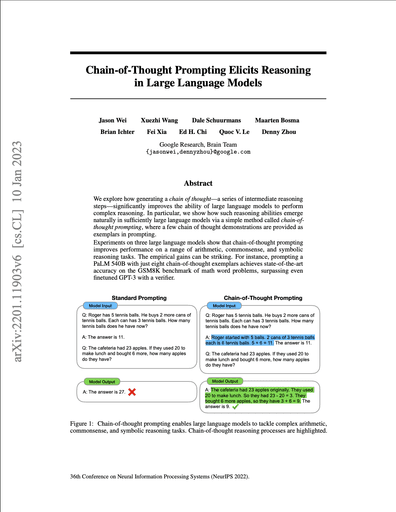
- Chain-of-Thought Prompting Elicits Reasoning in Large Language Models 2022 A landmark paper describing the Chain-of-Thought (CoT) technique. It shows that making large language models "think out loud" and break problems into small steps dramatically improves their performance in logic and math. A must-read that shows how a few examples in a prompt can replace expensive AI training. Discover the secrets of machine reasoning.
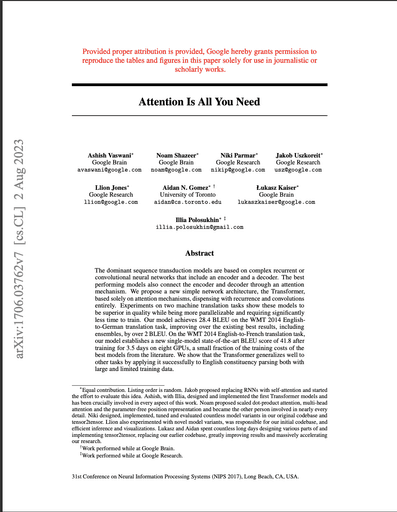
- Attention Is All You Need 2023 This paper is the foundation of today's AI revolution: the breakthrough work that introduced the Transformer architecture that ChatGPT and others are built on. You will learn how algorithms, thanks to the "attention mechanism", learned to understand wide context fluently and connect facts.
























No publications match these filters.