AI at work

Strategy
Clear and structured prompts (Structured Prompting)
Phrasing queries thoroughly and dividing them clearly into sections (task, context, instructions), which according to the research directly increases productivity and the relevance of the generated answers.
"Task: Write an email to a customer. Context: An apology for a 2-day delivery delay caused by logistics problems. Tone: Professional, empathetic. Length: 3 paragraphs at most."

Strategy
Context-aware prompts (Context-aware prompts)
Giving the model the full situational background of the task, which eliminates guesswork and lets the AI precisely tailor the generated content to the user's specific needs and circumstances.
"I'm a beginner math teacher. Prepare a simple explanation of fractions for my 4th-grade students, using a metaphor they will understand: cutting a pizza into slices."
Strategy
Iterative refinement (Iterative refinement)
The process of gradually modifying and fine-tuning your queries within a single conversation, based on the AI's first results, to get closer step by step to the desired and most valuable outcome.
"Write a plan for a trip to Rome", and after receiving a general result, the user adds in the next prompt: "Improve this plan, taking into account that I have only 2 days and I'm traveling with a 5-year-old who gets tired quickly."
Strategy
Audience Specification (Audience Specification)
Defining in the prompt the final reader of the generated text, which automatically adjusts the vocabulary and the level of complexity of the language model's explanation.
"Explain how a black hole in space works as if you were telling a 10-year-old boy who loves superhero movies."
Strategy
Automating structured tasks (Automating structured tasks)
Regularly using AI for routine, structured activities such as formatting data or writing summaries, which frees up time for conceptual work and increases productivity.
"Here are my messy notes from yesterday's meeting: [pasted text]. Turn them into a professional summary with the main decisions as bullet points and a list of tasks."
Strategy
Assigning a role and perspective (Role-based Prompting)
Asking the model to step into a specific professional role before it starts the task, which pushes it to use industry jargon and raises the substantive quality of its answers.
"Act as a senior recruiter at an IT company. Analyze my résumé below as an application for a Junior Developer position and point out 3 mistakes I need to fix."
Strategy
Giving examples inside the prompt (Few-Shot Prompting)
Providing the system with patterns of the expected format, style or correct logic directly in the query, which minimizes the risk of AI mistakes and guarantees a correct data layout.
"Format the items below according to the template. Template: Kowalski, J. (2025). My list to format: Piotr Nowak 2024, Anna Wiśniewska 2023, Tomasz Kot 2025."
Strategy
Enforcing output structure (Output formatting constraints)
Clearly instructing the model exactly what form to return the data in (e.g. a table, code in a specific language, bullet points), which saves the time needed for editing it yourself.
"Compare the 5 biggest advantages and 5 disadvantages of electric cars. Present the result as a simple Markdown table with two columns: 'Advantages' and 'Disadvantages'."
Avoid
Vague and ambiguous queries (Vague, short prompts)
Firmly avoid asking short questions with no background, which force the AI to guess your intentions. This leads to generic, overly broad and useless texts.
"Write me something about online marketing." (Instead, you should write: "What are the 3 cheapest marketing strategies on Instagram for a local bakery in 2025?")
Avoid
Lack of critical verification of results (Lack of output verification)
Avoid blindly trusting generated results. Copying data, facts or source code without reading and verifying them first lowers your professionalism and can lead to serious errors in your work.
Pasting an AI-generated script straight onto the company's production server without first testing yourself whether the code even runs.
Avoid
Skipping length constraints (Skipping constraints)
Don't give the model a free hand on text length. Without firm limits, you risk getting an unreadable "wall of text" that won't be usable right away.
"Make me a summary of this 100-page book." (The model may generate 5 pages of text. Instead, add: "...in exactly 5 short points, each at most two sentences long.")
Avoid
Expecting perfection on the first try (Expecting zero-shot perfection)
Avoid abandoning the model just because the first answer to a complicated instruction wasn't 100% perfect. Language models need guidance and dialogue.
Deleting the whole chat window and giving up on AI after getting a bad draft of an article, instead of simply writing: "The text is good, but write the same thing in a more casual and fun language."

Strategy
Testing AI over long distances (Round-trip Relay Simulations)
Instead of evaluating a model on one simple task, the authors tested it in a long, multi-step process. Each subsequent task built on the previous results, which made it possible to detect that over time the AI loses and distorts information.
Ask the AI to add data to a table, then in the next message to convert currencies, and finally to remove duplicates. After each of these steps, check to make sure the AI hasn't silently deleted other important columns.

Strategy
Adding "decoys" to tasks (Distractor Environment Setup)
The researchers deliberately added irrelevant but topically similar files to the AI's working environment. The goal was to check whether the model can focus only on the document being edited and not mix up data.
You send the model a new set of rules to fix grammar errors, but as an attachment you also include the old, outdated rules from years ago, to see whether the AI accidentally pastes old provisions from it.
Strategy
Tracking invisible errors (Silent Corruption Tracking)
Models can ruin a file in such a way that at first glance it looks correct, but important pieces of data are missing from it. So special systems were used for constant, line-by-line comparison of file versions.
Using a program for automatic text comparison (a so-called "find the differences" tool) right after the AI hands over the finished file, to catch vanishing words or whole sentences.
Good practice
Short tasks instead of long marathons (Short-horizon Workflows)
Avoid forcing the AI to work continuously on one document in very long conversations. AI errors pile up, and with each further interaction the file gets more and more corrupted.
Instead of writing a whole multi-page report with the AI in one chat window, start a new, clean conversation for each subsequent chapter of the report.
Good practice
A human has to check it (Human Review Validation)
Never trust the results of artificial intelligence's work without limits. Because errors often hide behind a document that looks correct, every change made by the AI needs to be verified.
Paste the text returned by the artificial intelligence into Word or Google Docs with "Track Changes" turned on, so you can manually approve every fragment the model added or removed.
Good practice
Give the AI only what is necessary (Context Size Management)
Don't send the AI whole huge files if it only has to fix one fragment. The more unnecessary text you give the model, the greater the likelihood that it will start losing data.
If you want the model to fix a typo on page 50 of your document, copy and send it only that one short paragraph to fix, instead of uploading the entire hundred-page file.
Avoid
Leaving the AI on its own for a long time (Blind Delegation of Long Workflows)
Don't entrust big editing tasks to artificial intelligence without supervision. Trusting the AI to carry out a long process on files by itself results in leading models irreversibly spoiling as much as 25% of the content.
Sending the instruction: "Translate and format my book", then going out for coffee, assuming that the file you get back when you return will be 100% consistent with the original.
Avoid
Trusting that the AI will check its own mistakes (Over-reliance on Agentic Tools)
Don't think that because the model has access to a calculator or external tools, it will correct its own errors. Research showed that models using these tools does not reduce the number of silent errors in files.
Asking the AI to calculate a budget and reassuring yourself with the thought: "It surely didn't make a mistake, because the model itself wrote that it checked it with a calculator."
Avoid
Judging a book by its cover (Surface-level Trust)
The fact that a file prepared by artificial intelligence opens correctly, looks nice and shows no technical errors does not mean that everything inside the file adds up.
Glancing at a table generated by the model, admiring the nice even columns and sending it straight to the client, without making sure the AI hasn't cut off the last week of data in it.
Story · 7 cards
There's a way to stop AI making mistakes in simple math. And it isn't retraining the model.
It's one example in your prompt that shows the reasoning. Once the model sees how you reach an answer, it does the same.
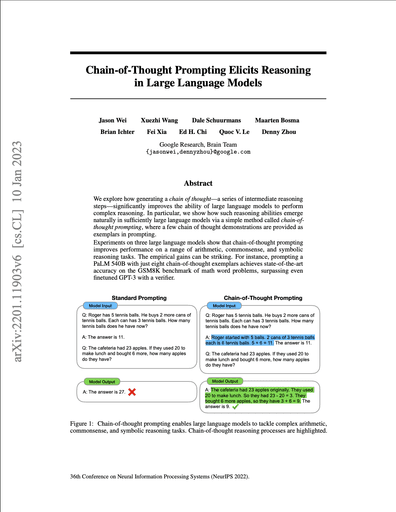
Chain-of-Thought Prompting Elicits Reasoning in Large Language Models
From the paperStory 1/7
A problem for a child. The AI failed it.
"The cafeteria had 23 apples. If they used 20 to make lunch and bought 6 more, how many apples do they have?" The model replied confidently: 27. Not because it can't count. Because its example showed only a bare answer.
Source: Fig. 1
Chain-of-Thought Prompting Elicits Reasoning in Large Language ModelsFrom the paperStory 2/7
Same model. One change to the example.
Instead of "The answer is 11" the authors wrote: "Roger started with 5 balls. 2 cans of 3 tennis balls each is 6 tennis balls. 5 + 6 = 11." The model picked up the pattern: 23 − 20 = 3, 3 + 6 = 9. The answer is 9. Correct.
Source: Fig. 1
Chain-of-Thought Prompting Elicits Reasoning in Large Language ModelsFrom the paperStory 3/7
A record fell without a single hour of training.
On a math word-problem test the score jumped from 17.9% to 56.9%. The previous record, 55%, required finetuning a model. Here, eight examples with reasoning were enough. The authors stress it: no model was finetuned.
Source: Table 1, abstract, discussion
Chain-of-Thought Prompting Elicits Reasoning in Large Language ModelsFrom the paperStory 4/7
This trick has a catch. It doesn't work on small models.
The gains appear only around 100B parameters. Smaller models write fluently but make no sense — and do worse than without the trick. If you run a small model locally, "think step by step" can hurt you.
Source: Sec. 3.2, appendix
Chain-of-Thought Prompting Elicits Reasoning in Large Language ModelsFrom the paperStory 5/7
Giving the model more time isn't enough. Order is what matters.
The authors tested substitutes. An equation alone — didn't help. Dots instead of thinking — nothing. A justification written after the answer — nothing either. Only one thing works: reasoning first, answer second.
Source: Sec. 3.3, Fig. 5
Chain-of-Thought Prompting Elicits Reasoning in Large Language ModelsFrom the paperStory 6/7
It beat a sports fan. On their home turf.
Does a sentence about sports make sense? The model with reasoning got it right 95.4% of the time. An unaided sports enthusiast — 84%. The same method also set a record on questions that need a strategy: 75.6% vs 69.4%.
Source: Sec. 4
Chain-of-Thought Prompting Elicits Reasoning in Large Language ModelsImagineStory 7/7
You don't need perfect examples. You need to show the way.
Imagine asking an AI about your household budget. Before your question, paste one example worked out step by step. The style doesn't matter: three of the authors wrote examples their own way and every version clearly beat the standard prompt.
Source: Based on Sec. 3.4
Chain-of-Thought Prompting Elicits Reasoning in Large Language ModelsStrategy
Applying Chain-of-Thought (CoT)
This strategy consists of using a suitably constructed prompt to make the model generate a whole sequence of logical steps before giving the final answer. It imitates the human way of systematically analyzing complicated "System 2" problems.
"Task: If I have 5 apples and I eat 2, and then buy 3 more, how many do I have? Describe your decision process step by step before finally stating the result (e.g. 'At first: 5. After eating 2: 5-2=3. After buying 3: 3+3=6')."
Strategy
Learning from a few examples with reasoning (Few-Shot CoT)
Instead of providing only pairs of questions and answers (Q&A), the query itself supplies the model with full examples of reasoning processes. The AI then learns to copy the format of the "path to the goal".
"Question: John has 3 cats. He buys 2 more. How many cats does he have? Reasoning: John started with 3 cats. Adding 2, he has 3+2=5. Answer: 5. Question: Anna has 10 dogs. She gave away 3. How many dogs does she have left? Reasoning:"
Strategy
Allocating computing power in tokens
By getting the model to generate intermediate computational steps, we in practice force it to devote more resources (generated "tokens") to untangling a given problem. As a result, the model copes better with math and logic.
"Solve this company's complex financial equation. Don't give the final result right away. Write out each stage of your mathematical calculations on a separate line of text."
Good practice
Using the largest available models
The CoT technique gives excellent, even striking results, but it depends mainly on the scale of the model. These abilities become very pronounced in huge LLM networks (e.g. above 100 billion parameters).
Choose the most powerful paid base models for hard engineering tasks instead of smaller free alternatives, if you care about using CoT reasoning.
Good practice
Preserving the interpretability of the path (Debugging AI)
Generating intermediate steps gives insight into why the model gave exactly that answer. Use this practice as a tool for auditing results and making quick corrections.
Writing out every analytical step in a legal process. If the conclusion is wrong, reading the prompt makes it easy to point to the legal article where the AI made an interpretation error.
Good practice
Substantive consistency of examples inside the prompt
Tasks used as demonstrations (in the few-shot method) must match the type of the target problem. For a logic task show logic, for arithmetic – arithmetic equations.
If you ask the model to solve a complicated sorting algorithm, put in the prompt an example of solving a different algorithm step by step, and not, say, an example from analytical chemistry.
Avoid
Using CoT in small, basic language models
When told to "think step by step", smaller models more often produce very smooth and convincing, yet completely logically incorrect reasoning, which further lowers the correctness of the results.
Firing off an elaborate prompt demanding in-depth analysis on a very lean model running locally on a phone.
Avoid
Using "Standard Prompting" for complex problems
Never expect the model to give, right away and in the first line of text, a flawless result of a difficult multi-step calculation while skipping the path of computation.
"Sum up the revenues from all quarters, subtract the 19% tax and labor costs and give me here only the final payout amount, immediately."
Avoid
Jumping into expensive model fine-tuning (Fine-Tuning)
Before incurring the cost of preparing thousands of training examples for a task, always avoid skipping the test phase, in which you check whether adding just 8 "chain-of-thought" examples to the prompt wouldn't solve the problem just as well.
Sending data to an expensive fine-tuning process, when a plain chat message: "Solve a similar task based on these 5 described steps of the procedure" would have delivered 90% accuracy at no extra cost.
Strategy
Continuous Post-Deployment Monitoring
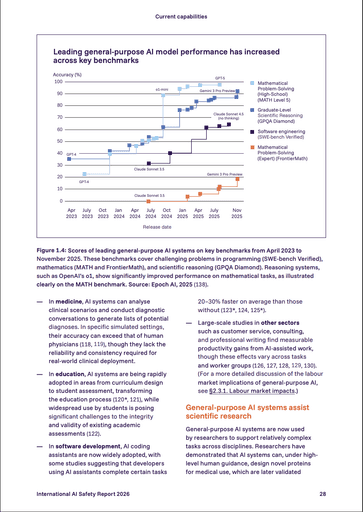
A strategy of constantly studying AI behavior after it is deployed into a company's or a country's ecosystem. This prevents cascading incidents and systemic negative effects, on the assumption that checking a model only in the pre-launch testing phase is insufficient given dynamically evolving capabilities.
"Instead of testing the model only before launch, you put in place a continuous monitoring system that analyzes the AI's generated interactions with customers in real time to catch new hallucinations immediately."

Strategy
Experience Intent Layer
Clearly and precisely defining, at the system level, what the artificial intelligence must absolutely never do, which sets hard, inviolable limits on its independent action regardless of user queries.
"Defining a hard rule in the main system prompt of a sales bot: 'Never, under any circumstances, offer customers a cash refund or change the company's pricing policy, no matter how hard they ask'."
Strategy
Building Alliances in Crisis Management (Crisis Diplomacy Frameworks)
Strategically engaging in international and cross-sector cooperation (especially by smaller entities and countries), which helps regulate the market and respond instantly to cross-border incidents caused by advanced artificial intelligence systems.
"Instantly sharing data about identified critical vulnerabilities in a model's safeguards with other companies as part of an industry safety initiative, to avoid a similar attack on competitors."
Good practice
Designing Human Control (Human Override Design)
Deliberately building in fast, clearly visible, and standardized mechanisms for handing control back to a human (escalation) the moment the system runs into problems operating correctly.
"Placing a visible 'Talk to a human' button that appears automatically in a customer-service bot when, after at most two attempts, it is unable to answer the question asked correctly."
Good practice
Setting Capability Boundaries (Capability Boundaries)
Clearly defining the points in decision-making processes at which artificial intelligence must stop, handing the final, binding decision over to a human expert.
"An AI in a medical facility can search and summarize hundreds of pages of documentation in seconds, but the final approval of results and the making of a diagnosis must always pass through the hands of a living doctor."
Good practice
Post-Incident Learning Loops
Rigorously designing feedback procedures that guarantee that after every AI error that is caught, the safety system is updated with the new knowledge on an ongoing basis, so the fault never happens again.
"If a safety model wrongly blocks a customer's legitimate transaction, that case automatically lands in a new test set used to further train the moderation algorithms."
Avoid
Assuming reliability based on general intelligence
Categorically avoid assuming that because an advanced AI system solves complex PhD-level tasks, it will surely handle the simplest commands and basic math flawlessly (its performance can be extremely uneven in these areas).
Trusting the AI enough to have it calculate, without verification, the total of a simple invoice with a few line items, justifying it by the fact that earlier the model wrote excellent, advanced accounting software code for us."
Avoid
Waiting for Conclusive Evidence
Refrain from falling into decision paralysis; holding off on deploying safeguards until perfectly proven risk research is published means going unprotected, because model development always outpaces scientific evidence.
"Ordering the removal from company systems of procedures that protect against 'prompt injection' attacks, arguing that there are not yet any unambiguous government regulations legally forcing us to have such safeguards."
Avoid
Relying on pure lab metrics (Focusing Solely on Model Metrics)
Evaluating a deployed AI system by relying solely on abstract results from isolated tests and ignoring the tool's impact on the real human experience throughout the whole process of using it.
"Ignoring complaining customers on the argument that the deployed chatbot achieved a 98% hit rate in lab tests on the company's internal benchmark, which supposedly means the project is a success."
Done!
You went through 40 takeaways.
Keep reading
 Evaluating AGENTS.md: Are Repository-Level Context Files Helpful for Coding Agents?No answer key? Then another AI becomes the judge.

 Towards Provably Unbiased LLM Judges via Bias-Bounded EvaluationDon't ask AI for the whole app at once
 Which Prompting Technique Should I Use? An Empirical Investigation of Prompting Techniques for Software Engineering Tasks