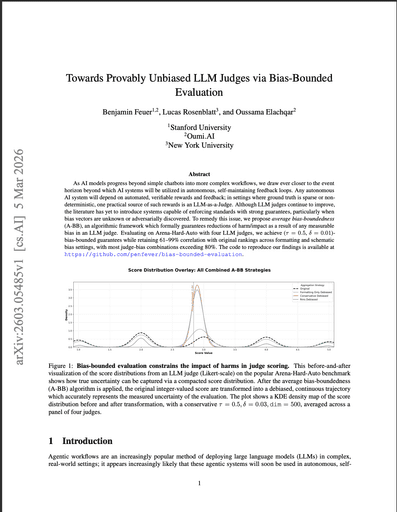
Takeaways: Towards Provably Unbiased LLM Judges via Bias-Bounded Evaluation
Strategy
Using an LLM as a Judge (LLM-as-a-Judge)
The practical use of large language models to automatically evaluate and reward other AI systems in environments where hard, verifiable reference data (ground truth) is lacking.
"Act as an objective judge. Evaluate the answer below, generated by a chatbot, for precision and usefulness, giving it a score on a scale of 1 to 10, and justify your assessment."

Strategy
Implementing the Average Bias-Boundedness (A-BB) framework
Using mathematical algorithms that formally limit the influence of a model's systematic errors on the final evaluation result. This makes it possible to stay objective even when the causes of the model's biases are complex or unknown.
Imagine that a sports judge always subconsciously favors athletes in red jerseys. This system is a kind of digital filter that automatically notices this error and corrects it, making the scoring fair again.
Strategy
Counteracting uncertainty through controlled noise
A strategy of deliberately and repeatedly introducing small changes to the way questions are asked, in order to rule out random errors during evaluation.
Prompt
Good practice
Measuring the natural variance of scores (Inherent jitter)
Run several evaluation attempts on the same problem before you start making corrections. This will show you whether the AI is just handing out random scores.
Ask the artificial intelligence to evaluate the same text five times in a row. If it gives a completely different result each time (e.g., 2/10 once and 9/10 another time), that is a sign its scores are unstable.
Good practice
Preserving ranking correlation while correcting bias
When fixing the errors of an AI judge, make sure you don't change the actual quality of the programs being evaluated.
When you introduce corrections meant to remove errors in grading, make sure at the end that the student (or program) who objectively wrote the best work still holds first place on the ranking list.
Avoid
Blind trust in autonomous evaluation loops (Blind trust in autonomous loops)
Avoid leaving AI programs to themselves, with one creating content and another approving it, without safety mechanisms in place.
Never let, for example, one bot write emails and another automatically send them to customers based on its own unsupervised judgment. Without oversight, the bots can start accepting gibberish.
Avoid
Ignoring hidden biases
Don't assume a language model is objective just because profanity or racism has been blocked in it. There are errors that are far harder to detect.
You may think that an AI evaluating résumés treats everyone as equal, while the system quietly rejects candidates who didn't use a particular trendy corporate buzzword in their text.
Avoid
Inconsistency between the overall score and the criteria (Schematic adherence bias)
Avoid accepting the AI's final verdicts that have no logical support in its partial scores.
Watch out for situations where the AI gives very poor partial scores (e.g., "very many spelling errors", "no logic"), but at the end, for some reason, issues a final score of 10/10.
Done!
You went through 8 takeaways.
Keep reading
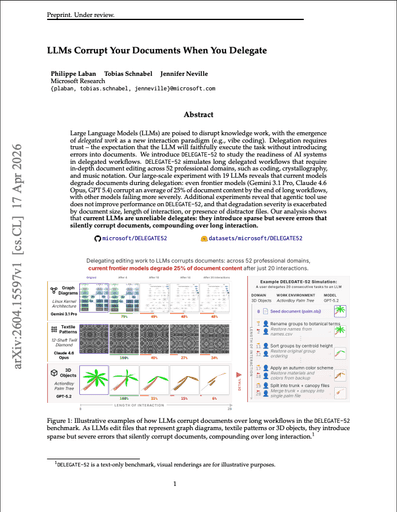
 LLMs Corrupt Your Documents When You DelegateHow many eyes does the sun have? AI knows it's nonsense. You have to draw it out.
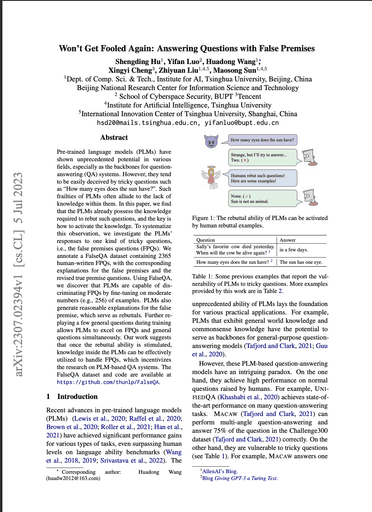
 Won't Get Fooled Again: Answering Questions with False PremisesMore instructions for your agent, worse results? Measure it.
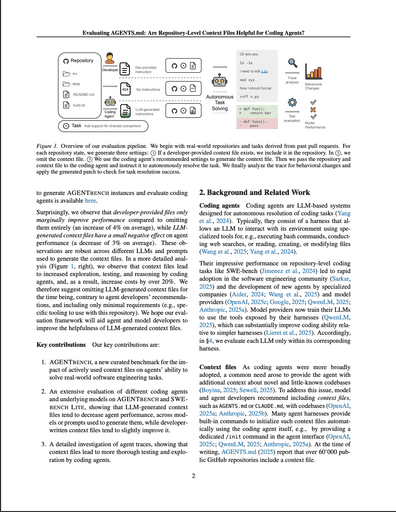
 Evaluating AGENTS.md: Are Repository-Level Context Files Helpful for Coding Agents?