Agentic approach
Strategy
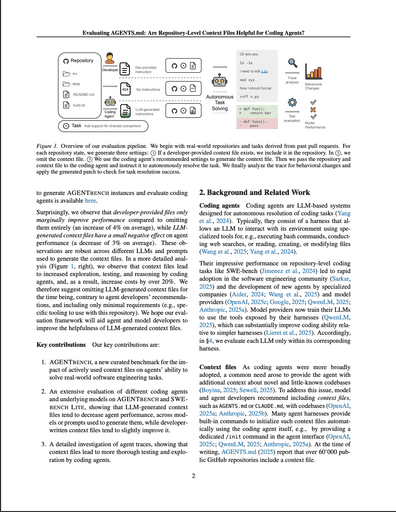
Measuring the real impact of context
Instead of assuming that extra files like AGENTS.md always help the AI, you should measure their impact on specific tasks. Studies have shown that adding extensive, generated context often even lowers the problem-solving success rate by a few percent.
Run A/B tests for your coding agent. Have it fix 5 bugs with an AGENTS.md file and 5 without it, then objectively compare in which case the success rate was higher.

Strategy
Focusing on surgical intervention (Surgical Intervention)
Context files should resolve only those ambiguities that the code and the agent's built-in tools cannot handle on their own. The report prescribes treating these files as a collection of "expensive truths," not universal documentation.Explanation or promptAnalyzing whether, while writing a very polite email for a user, the artificial intelligence secretly activates concepts such as "manipulation" or "deception".
Evaluating AGENTS.md: Are Repository-Level Context Files Helpful for Coding Agents?Strategy
Looking for the "workspace" (Global Workspace)
Isolating the fact that the AI has a special place in its virtual brain where it keeps temporary, important information needed to solve a problem, separating it from the ordinary assembling of sentences.
When you ask an AI to put together a trip plan, the system keeps information about the budget in its virtual "scratch pad" so it doesn't suddenly forget it halfway through writing the answer.
Strategy
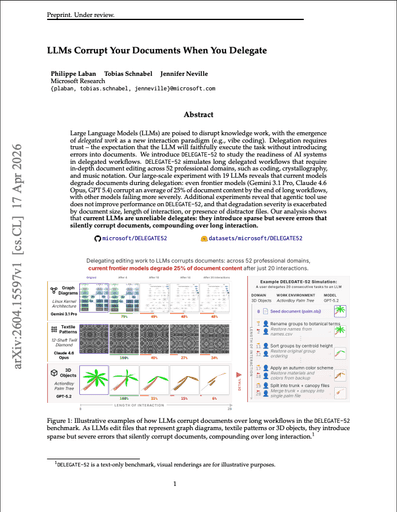
Testing AI over long distances (Round-trip Relay Simulations)
Instead of evaluating a model on one simple task, the authors tested it in a long, multi-step process. Each subsequent task built on the previous results, which made it possible to detect that over time the AI loses and distorts information.
Ask the AI to add data to a table, then in the next message to convert currencies, and finally to remove duplicates. After each of these steps, check to make sure the AI hasn't silently deleted other important columns.

Strategy
Adding "decoys" to tasks (Distractor Environment Setup)
The researchers deliberately added irrelevant but topically similar files to the AI's working environment. The goal was to check whether the model can focus only on the document being edited and not mix up data.
You send the model a new set of rules to fix grammar errors, but as an attachment you also include the old, outdated rules from years ago, to see whether the AI accidentally pastes old provisions from it.
Strategy
Tracking invisible errors (Silent Corruption Tracking)
Models can ruin a file in such a way that at first glance it looks correct, but important pieces of data are missing from it. So special systems were used for constant, line-by-line comparison of file versions.
Using a program for automatic text comparison (a so-called "find the differences" tool) right after the AI hands over the finished file, to catch vanishing words or whole sentences.
Good practice
Short tasks instead of long marathons (Short-horizon Workflows)
Avoid forcing the AI to work continuously on one document in very long conversations. AI errors pile up, and with each further interaction the file gets more and more corrupted.
Instead of writing a whole multi-page report with the AI in one chat window, start a new, clean conversation for each subsequent chapter of the report.
Good practice
A human has to check it (Human Review Validation)
Never trust the results of artificial intelligence's work without limits. Because errors often hide behind a document that looks correct, every change made by the AI needs to be verified.
Paste the text returned by the artificial intelligence into Word or Google Docs with "Track Changes" turned on, so you can manually approve every fragment the model added or removed.
Good practice
Give the AI only what is necessary (Context Size Management)
Don't send the AI whole huge files if it only has to fix one fragment. The more unnecessary text you give the model, the greater the likelihood that it will start losing data.
If you want the model to fix a typo on page 50 of your document, copy and send it only that one short paragraph to fix, instead of uploading the entire hundred-page file.
Avoid
Leaving the AI on its own for a long time (Blind Delegation of Long Workflows)
Don't entrust big editing tasks to artificial intelligence without supervision. Trusting the AI to carry out a long process on files by itself results in leading models irreversibly spoiling as much as 25% of the content.
Sending the instruction: "Translate and format my book", then going out for coffee, assuming that the file you get back when you return will be 100% consistent with the original.
Avoid
Trusting that the AI will check its own mistakes (Over-reliance on Agentic Tools)
Don't think that because the model has access to a calculator or external tools, it will correct its own errors. Research showed that models using these tools does not reduce the number of silent errors in files.
Asking the AI to calculate a budget and reassuring yourself with the thought: "It surely didn't make a mistake, because the model itself wrote that it checked it with a calculator."
Avoid
Judging a book by its cover (Surface-level Trust)
The fact that a file prepared by artificial intelligence opens correctly, looks nice and shows no technical errors does not mean that everything inside the file adds up.
Glancing at a table generated by the model, admiring the nice even columns and sending it straight to the client, without making sure the AI hasn't cut off the last week of data in it.
Strategy
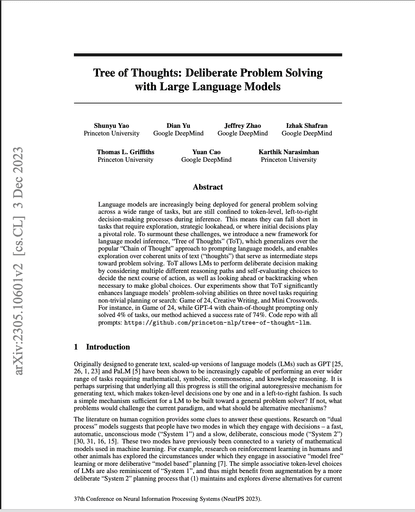
Tree of Thoughts architecture (Tree of Thoughts)
Instead of a single, linear path to an answer, the model branches its reasoning into a web of different variants (a tree). It generates several possible next steps from one point, creating alternative scenarios for solving the problem. Explanation or prompt"Propose 3 different concepts for solving this algorithmic problem. For each of these concepts, then add 2 further steps showing how it could be developed, and then choose the one with the greatest potential."
Tree of Thoughts: Deliberate Problem Solving with Large Language Models
Strategy
Built-in self-evaluation of states (Self-Evaluation)
A key mechanism in which the artificial intelligence itself checks, at every step, whether its assumptions so far make sense. It rates the generated "thoughts" as promising, doubtful or wrong before spending resources on continuing them. Explanation or prompt"Analyze the paragraph of text you just generated and rate on a scale of 1 to 10 how well it fulfills the main logical assumptions of my prompt. If it received a score lower than 7, ignore it completely."
Tree of Thoughts: Deliberate Problem Solving with Large Language ModelsStrategy
Graph search and backtracking (Search Algorithms & Backtracking)
A technique of applying search algorithms known from computer science (breadth-first or depth-first). When the model runs into a contradiction or decides a branch is wrong, it stops that line of thought and "backtracks" to an earlier correct decision point to explore a different branch.
"Start solving this puzzle step by step. If at any stage your reasoning leads to a contradiction with the rules of the puzzle, write 'ERROR', go back to the previous stage and propose a different way of calculating."
Good practice
Defining the right scale of a "Thought"
A reasoning step for the model should be big enough to be substantively meaningful for evaluating the final solution, but small enough that many precise variants of it can be generated.
When generating code, the "thought" and the evaluation point should be coming up with an idea for a single class in the architecture, rather than asking to evaluate every generated line separately.
Good practice
Varying the voting methods (Flexible Evaluation Methods)
The choice of self-evaluation method should depend on the task. For analytical tasks (math, programming) it is better to flatly reject contradictions; for creative ones, continuous evaluation (e.g. assigning points/stars to individual ideas).
"Create 4 variants of a book title, then give them points from 0 to 5 for emotional resonance. Pass only the variant with the highest score on to the next step."
Good practice
Strategic lookahead (Lookahead)
When a problem is complex, it is worth asking the model, before it makes a final decision about the path, to briefly simulate where a given path would ultimately lead it and what obstacles may arise.
"Before you start writing the full script with this particular storyline, list the 2 biggest plot holes that may appear if we use this solution."
Avoid
A linear approach to tasks with difficult planning (Left-to-Right Limits)
Avoid forcing the model to solve games and complicated multi-step problems with traditional methods that generate the result straight ahead with no option to correct, so that a single mistake cascades and ruins everything else.
"Solve this hard Sudoku puzzle step by step from the left side of the grid downward and don't change the digits you've already set."
Avoid
Blindly pushing on into hallucinations with no pauses for evaluation
What we avoid is relying on a continuous stream of generation in which we give the artificial intelligence no clear checkpoint for reflection: "does what I just wrote make sense?".
"Write a non-stop 3,000 words of an intricate geopolitical plan and give me the finished text right away." (Instead of asking it to come up with 3 theses, verify them, and only then develop them.)
Avoid
Overusing ToT on trivial tasks
The Tree of Thoughts framework uses a very large number of tokens and significantly lengthens the time needed to generate an answer. You shouldn't use complex branching instructions for trivial informational requests.
"Design a three-level tree of thoughts, with 3 branches at each level, and rate each branch on a 10-point scale to determine what the formula for the area of a square is."
Strategy
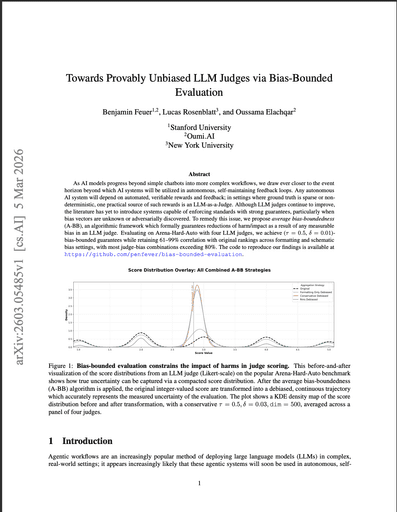
Using an LLM as a Judge (LLM-as-a-Judge)
The practical use of large language models to automatically evaluate and reward other AI systems in environments where hard, verifiable reference data (ground truth) is lacking.
"Act as an objective judge. Evaluate the answer below, generated by a chatbot, for precision and usefulness, giving it a score on a scale of 1 to 10, and justify your assessment."

Strategy
Implementing the Average Bias-Boundedness (A-BB) framework
Using mathematical algorithms that formally limit the influence of a model's systematic errors on the final evaluation result. This makes it possible to stay objective even when the causes of the model's biases are complex or unknown.
Imagine that a sports judge always subconsciously favors athletes in red jerseys. This system is a kind of digital filter that automatically notices this error and corrects it, making the scoring fair again.
Strategy
Counteracting uncertainty through controlled noise
A strategy of deliberately and repeatedly introducing small changes to the way questions are asked, in order to rule out random errors during evaluation.
Prompt
Good practice
Measuring the natural variance of scores (Inherent jitter)
Run several evaluation attempts on the same problem before you start making corrections. This will show you whether the AI is just handing out random scores.
Ask the artificial intelligence to evaluate the same text five times in a row. If it gives a completely different result each time (e.g., 2/10 once and 9/10 another time), that is a sign its scores are unstable.
Good practice
Preserving ranking correlation while correcting bias
When fixing the errors of an AI judge, make sure you don't change the actual quality of the programs being evaluated.
When you introduce corrections meant to remove errors in grading, make sure at the end that the student (or program) who objectively wrote the best work still holds first place on the ranking list.
Avoid
Blind trust in autonomous evaluation loops (Blind trust in autonomous loops)
Avoid leaving AI programs to themselves, with one creating content and another approving it, without safety mechanisms in place.
Never let, for example, one bot write emails and another automatically send them to customers based on its own unsupervised judgment. Without oversight, the bots can start accepting gibberish.
Avoid
Ignoring hidden biases
Don't assume a language model is objective just because profanity or racism has been blocked in it. There are errors that are far harder to detect.
You may think that an AI evaluating résumés treats everyone as equal, while the system quietly rejects candidates who didn't use a particular trendy corporate buzzword in their text.
Avoid
Inconsistency between the overall score and the criteria (Schematic adherence bias)
Avoid accepting the AI's final verdicts that have no logical support in its partial scores.
Watch out for situations where the AI gives very poor partial scores (e.g., "very many spelling errors", "no logic"), but at the end, for some reason, issues a final score of 10/10.
Strategy
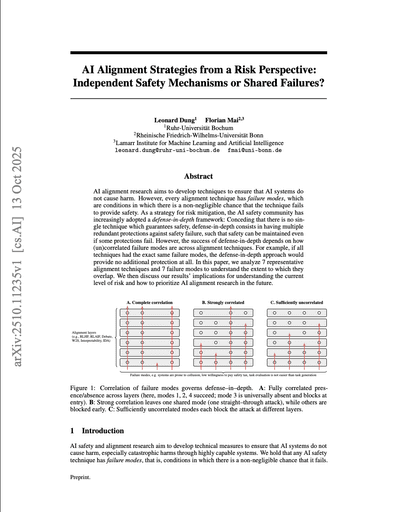
Defense-in-depth
A strategy of building many redundant layers of safeguards, acknowledging that no single technique guarantees 100% safety. This minimizes the risk of total system failure.
"Propose at least three mutually independent layers of protection for this system, so that the failure of one does not compromise the whole."

Strategy
Correlated Failure Analysis
Assessing how far different safety mechanisms share the same failure points (so-called Shared Failures). If the layers fail for the same reason, the additional safeguards are useless.
"Analyze these two verification methods and assess whether both would stop working at the same time if the wireless network failed."
Strategy
Failure Mode Categorization
The paper categorizes 7 key critical points (e.g. deceptive alignment or the AI's tendency to collude) in order to map the gaps in current safety techniques more precisely.
"Identify and describe 5 potential failure modes for a newly written algorithm before it is deployed to production."
Good practice
Prioritizing independent mechanisms
Building safeguard techniques whose failure modes are orthogonal (unrelated to one another), to minimize the risk of the entire defense system collapsing at once.
"Design a second data evaluation mechanism that uses completely different logic and independent sources of information from the first algorithm."
Good practice
Assumption of Failure
An approach that assumes up front that every technique has conditions under which there is a non-zero probability of error, which forces the building of systems that are highly resilient to incidents.
"Prepare an incident response procedure assuming up front that the system's main firewall has just been completely breached."
Good practice
Holistic Risk Evaluation
Assessing the current level of threat by analyzing the whole ecosystem of connected safeguards, rather than isolated tests of a single protective method.
"Assess the overall risk for this project, taking into account the interactions and dependencies between all the security layers deployed earlier."
Avoid
Relying on correlated safeguards (Shared Failures)
Avoid the illusion of safety that comes from using many protection methods if they all rest on the same foundation and are vulnerable to the same attack vector.
"Point out potential weak spots, showing why a password, an SMS token and e-mail authorization all become useless after an unlocked phone is stolen."
Avoid
Ignoring Deceptive Alignment
Do not downplay the risk that AI models may deliberately hide their errors or true intentions during the process of testing their safety.
"Design the test environment for this AI bot in such a way that the algorithm is unable to tell that its responses are currently being evaluated."
Avoid
Naive belief that tasks are easy to evaluate (Evaluation Fallacy)
Avoid assuming that verifying data (e.g. complicated code or a medical decision) is always simpler and safer than having the AI generate the solution itself.
"Propose a multi-step process for verifying this complicated AI-generated code, without relying solely on a quick visual review by a programmer."
Done!
You went through 38 takeaways.
Keep reading
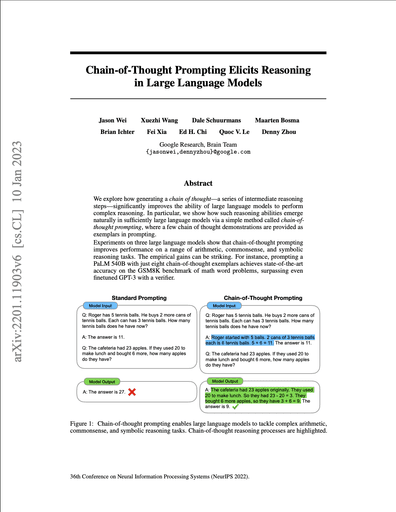
 Chain-of-Thought Prompting Elicits Reasoning in Large Language ModelsDon't ask AI for the whole app at once
 Which Prompting Technique Should I Use? An Empirical Investigation of Prompting Techniques for Software Engineering TasksHow many eyes does the sun have? AI knows it's nonsense. You have to draw it out.
 Won't Get Fooled Again: Answering Questions with False Premises