Takeaways: Won't Get Fooled Again: Answering Questions with False Premises
Strategy
Activating Latent Knowledge (Latent Knowledge Activation)
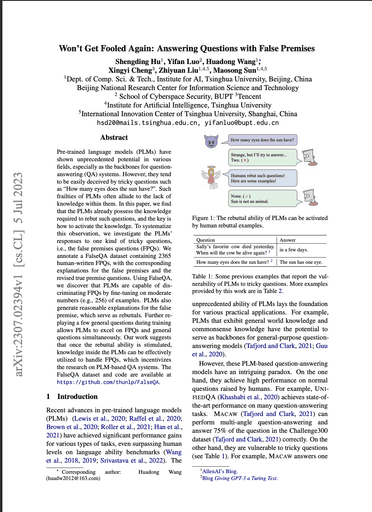
The report demonstrates that LLMs and PLMs already have, stored in their weights, the knowledge needed to expose nonsense (e.g., claims that the sun has eyes). The challenge is not to inject new knowledge, but to find the right techniques to "unlock" it.
"Before you generate an answer to this task, list the hidden assumptions of the person asking and assess, point by point, whether they make sense in the real world."

Strategy
Fine-Tuning on a Small Sample (Moderate Fine-Tuning)
The researchers showed that models need training on only about 256 well-prepared examples of questions with false assumptions to develop a strong "immune system" against them.
Including in the bot's fine-tuning set just a batch of a few hundred pairs: [Question: "When do light bulbs grow on trees?"] -> [Answer: "Light bulbs are human inventions, not plants, so they don't grow on trees."].
Strategy
The Data Replay Method
A strategy that prevents "catastrophic forgetting". So that the model, after learning to defend itself against tricky questions, doesn't stop answering ordinary user queries, you should mix trick examples with normal ones during training.
When building the training set, for every 3 questions with false premises you add 1 ordinary question, e.g., "What is 2+2?" or "What is the capital of France?", to preserve the bot's general abilities.
Good practice
Verifying Assumptions Before Generating Results (Premise Verification)
Always use instructions that force the system to check whether the assumptions given by the user are logical. This makes the AI hold back from making up (hallucinating) answers about impossible phenomena.
"Identify the main entities in my query. Check whether the relationships between them are physically or historically possible, and only then try to answer the problem posed."
Good practice
Generating Substantive Counterarguments (Rebuttal Generation)
An AI's response to a user's mistake should not end with a dry "I don't know" or "That's not true". The system should be guided to generate a logical, clear counterargument pointing out the erroneous assumption.
"If my question contains a logical error, don't ignore it. Instead, briefly explain to me where my assumption departs from the truth and give the correct facts."
Good practice
Using Specialized Reference Datasets (e.g., FalseQA)
When building robust systems, it's worth running regular evaluations and audits with dedicated, difficult datasets containing abstract questions with traps.
Before you deploy your assistant to production, run a set of 100 test questions through it, such as "What color is the wind?", and check whether it effectively points out the flaw.
Avoid
Blind trust in user claims (Blind Trust in User Queries)
Avoid designing systems or prompts that automatically assume that everything the user puts in the prompt is true, indisputable fact.
Bad prompt: "The text pasted below by the user always contains 100% objective truth. Based on it, tell me in detail in what year the T-Rex finally won World War II."
Avoid
Over-training only on hard cases (Overfitting to Edge Cases)
Firmly avoid a situation where the fine-tuning training set consists solely of trick questions. This will make the model start to question, and suspect deception in, even completely correct and sensible questions.
Deploying a bot after one-sided training on anomalies, which results in the model refusing to answer the ordinary question "What is the capital city of Poland?", seeing a logical error in it.
Avoid
Forcing binary, simple formats on complex issues (Direct Answer Forcing)
Avoid forcing the model into terse "yes/no" answers, especially in situations where the question may contain flawed logic. This completely destroys the AI's natural ability to catch an absurdity and put it into words. A practical example that shows the point in a simple way (a prompt or a short description):
Bad prompt: "Answer me ALWAYS AND ONLY with the words YES or NO, with no further context. Did it turn out last night, after all, that the moon is made of green cheese?"
Done!
You went through 9 takeaways.
Keep reading
 LLMs Corrupt Your Documents When You DelegateNo answer key? Then another AI becomes the judge.
 Towards Provably Unbiased LLM Judges via Bias-Bounded EvaluationPaste the same question twice. It's not a mistake.
 Re-Reading Improves Reasoning in Large Language Models