Takeaways: AI Alignment Strategies from a Risk Perspective: Independent Safety Mechanisms or Shared Failures?
Strategy
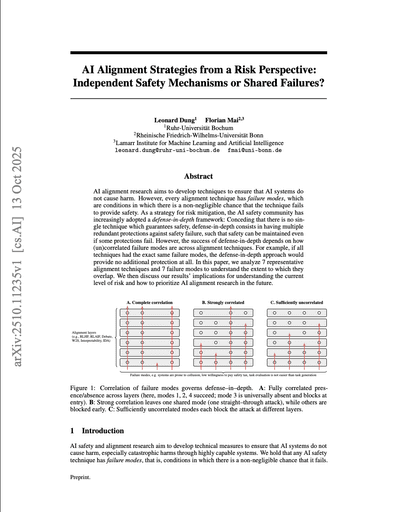
Defense-in-depth
A strategy of building many redundant layers of safeguards, acknowledging that no single technique guarantees 100% safety. This minimizes the risk of total system failure.
"Propose at least three mutually independent layers of protection for this system, so that the failure of one does not compromise the whole."

Strategy
Correlated Failure Analysis
Assessing how far different safety mechanisms share the same failure points (so-called Shared Failures). If the layers fail for the same reason, the additional safeguards are useless.
"Analyze these two verification methods and assess whether both would stop working at the same time if the wireless network failed."
Strategy
Failure Mode Categorization
The paper categorizes 7 key critical points (e.g. deceptive alignment or the AI's tendency to collude) in order to map the gaps in current safety techniques more precisely.
"Identify and describe 5 potential failure modes for a newly written algorithm before it is deployed to production."
Good practice
Prioritizing independent mechanisms
Building safeguard techniques whose failure modes are orthogonal (unrelated to one another), to minimize the risk of the entire defense system collapsing at once.
"Design a second data evaluation mechanism that uses completely different logic and independent sources of information from the first algorithm."
Good practice
Assumption of Failure
An approach that assumes up front that every technique has conditions under which there is a non-zero probability of error, which forces the building of systems that are highly resilient to incidents.
"Prepare an incident response procedure assuming up front that the system's main firewall has just been completely breached."
Good practice
Holistic Risk Evaluation
Assessing the current level of threat by analyzing the whole ecosystem of connected safeguards, rather than isolated tests of a single protective method.
"Assess the overall risk for this project, taking into account the interactions and dependencies between all the security layers deployed earlier."
Avoid
Relying on correlated safeguards (Shared Failures)
Avoid the illusion of safety that comes from using many protection methods if they all rest on the same foundation and are vulnerable to the same attack vector.
"Point out potential weak spots, showing why a password, an SMS token and e-mail authorization all become useless after an unlocked phone is stolen."
Avoid
Ignoring Deceptive Alignment
Do not downplay the risk that AI models may deliberately hide their errors or true intentions during the process of testing their safety.
"Design the test environment for this AI bot in such a way that the algorithm is unable to tell that its responses are currently being evaluated."
Avoid
Naive belief that tasks are easy to evaluate (Evaluation Fallacy)
Avoid assuming that verifying data (e.g. complicated code or a medical decision) is always simpler and safer than having the AI generate the solution itself.
"Propose a multi-step process for verifying this complicated AI-generated code, without relying solely on a quick visual review by a programmer."
Done!
You went through 9 takeaways.
Keep reading
 International AI Safety Report 2026
 Towards Provably Unbiased LLM Judges via Bias-Bounded Evaluation
 AI Alignment: A Comprehensive Survey