Takeaways: AI Alignment: A Comprehensive Survey
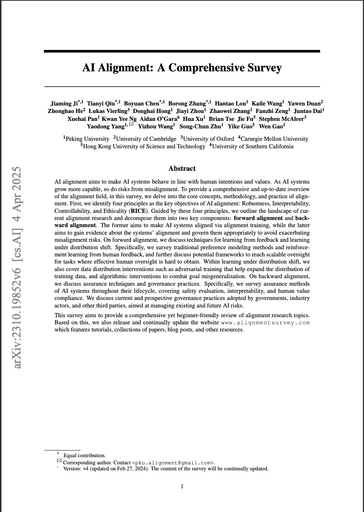
Strategy
The RICE framework (Robustness, Interpretability, Controllability, Ethicality)
A comprehensive approach that defines four main pillars of safe AI: the model must be resilient to errors, its decisions must be understandable, a human must keep control over it, and its behavior itself must be ethical.
"Review this medical algorithm's response against the RICE model: is it free of errors, can you explain what it results from, can it be reversed at any moment, and does it avoid discriminating against the patient?"

Strategy
Forward Alignment
Strategies applied during the learning and training process itself, meant to proactively instill the desired human values and goals in the model before it is even fully finished.
"Create a training dataset in which every technically correct answer that nevertheless contains toxic language receives a negative rating during training."
Strategy
Backward Alignment
Techniques for auditing, evaluating and governing a model after it has already been trained. Their aim is to gather hard evidence that the model really behaves as we assumed, and to verify its safety in practice before it is widely deployed.
"Run an automated safety test on the already deployed production chatbot, trying to push it into breaking its own safety rules (red-teaming)."
Good practice
Learning from Feedback
Using human ratings (e.g. RLHF) at massive scale to correct a system's outputs. The system learns from what people prefer, which helps it align better with natural language and human expectations.
"Analyze these two generated answers to the customer's question and judge which one is more helpful and safe, justifying your choice for AI training purposes."
Good practice
Scalable Oversight
Using smaller, specialized AI tools or advanced techniques of systems working together to supervise and check much larger and more powerful models, which a human can no longer fully inspect on their own, line by line.
"Design a prompt for an auxiliary AI assistant whose only job is to continuously monitor the logs of the main decision-making model and raise the alarm if it detects dangerous intentions."
Good practice
Governance and Assurance
Setting firm organizational procedures and technical methods covering the entire AI life cycle, ensuring constant control over the system.
"Create a verification checklist that every updated language model must pass before a new patch of neural network weights goes onto public servers."
Avoid
Naively relying on the test environment (Ignoring Distribution Shift)
Avoid assuming that if a system worked perfectly and in a controlled way on the training data, it will keep its moral alignment when it collides with a completely new and chaotic environment (e.g. real-time internet access).
"Identify and explain technically, step by step, which specific variables and weights in this model's architecture led it to make exactly this credit decision."
Avoid
Treating safety as a one-time process
Avoid the mistaken belief that a training process enforcing correct behavior (Forward Alignment) is enough. Without continuous monitoring, verification of goals in a changing world, and governance, the system's safety degrades quickly.
"Design an annual plan for continuously monitoring this financial algorithm, including monthly red-teaming stress tests, even if the algorithm's code itself does not change at all during that time."
Done!
You went through 8 takeaways.
Keep reading
 The Alignment Problem from a Deep Learning Perspective
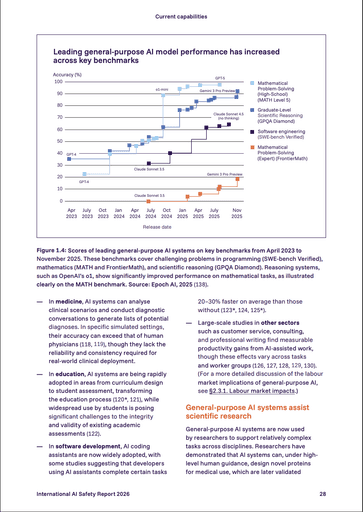
 International AI Safety Report 2026
 Towards Provably Unbiased LLM Judges via Bias-Bounded Evaluation