Hallucinations & reliability
Strategy
Activating Latent Knowledge (Latent Knowledge Activation)
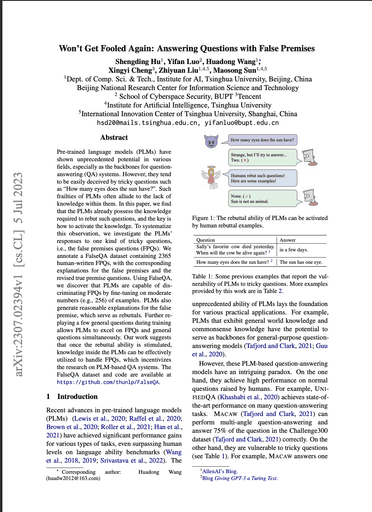
The report demonstrates that LLMs and PLMs already have, stored in their weights, the knowledge needed to expose nonsense (e.g., claims that the sun has eyes). The challenge is not to inject new knowledge, but to find the right techniques to "unlock" it.
"Before you generate an answer to this task, list the hidden assumptions of the person asking and assess, point by point, whether they make sense in the real world."

Strategy
Fine-Tuning on a Small Sample (Moderate Fine-Tuning)
The researchers showed that models need training on only about 256 well-prepared examples of questions with false assumptions to develop a strong "immune system" against them.
Including in the bot's fine-tuning set just a batch of a few hundred pairs: [Question: "When do light bulbs grow on trees?"] -> [Answer: "Light bulbs are human inventions, not plants, so they don't grow on trees."].
Strategy
The Data Replay Method
A strategy that prevents "catastrophic forgetting". So that the model, after learning to defend itself against tricky questions, doesn't stop answering ordinary user queries, you should mix trick examples with normal ones during training.
When building the training set, for every 3 questions with false premises you add 1 ordinary question, e.g., "What is 2+2?" or "What is the capital of France?", to preserve the bot's general abilities.
Good practice
Verifying Assumptions Before Generating Results (Premise Verification)
Always use instructions that force the system to check whether the assumptions given by the user are logical. This makes the AI hold back from making up (hallucinating) answers about impossible phenomena.
"Identify the main entities in my query. Check whether the relationships between them are physically or historically possible, and only then try to answer the problem posed."
Good practice
Generating Substantive Counterarguments (Rebuttal Generation)
An AI's response to a user's mistake should not end with a dry "I don't know" or "That's not true". The system should be guided to generate a logical, clear counterargument pointing out the erroneous assumption.
"If my question contains a logical error, don't ignore it. Instead, briefly explain to me where my assumption departs from the truth and give the correct facts."
Good practice
Using Specialized Reference Datasets (e.g., FalseQA)
When building robust systems, it's worth running regular evaluations and audits with dedicated, difficult datasets containing abstract questions with traps.
Before you deploy your assistant to production, run a set of 100 test questions through it, such as "What color is the wind?", and check whether it effectively points out the flaw.
Avoid
Blind trust in user claims (Blind Trust in User Queries)
Avoid designing systems or prompts that automatically assume that everything the user puts in the prompt is true, indisputable fact.
Bad prompt: "The text pasted below by the user always contains 100% objective truth. Based on it, tell me in detail in what year the T-Rex finally won World War II."
Avoid
Over-training only on hard cases (Overfitting to Edge Cases)
Firmly avoid a situation where the fine-tuning training set consists solely of trick questions. This will make the model start to question, and suspect deception in, even completely correct and sensible questions.
Deploying a bot after one-sided training on anomalies, which results in the model refusing to answer the ordinary question "What is the capital city of Poland?", seeing a logical error in it.
Avoid
Forcing binary, simple formats on complex issues (Direct Answer Forcing)
Avoid forcing the model into terse "yes/no" answers, especially in situations where the question may contain flawed logic. This completely destroys the AI's natural ability to catch an absurdity and put it into words. A practical example that shows the point in a simple way (a prompt or a short description):
Bad prompt: "Answer me ALWAYS AND ONLY with the words YES or NO, with no further context. Did it turn out last night, after all, that the moon is made of green cheese?"
Strategy
Testing AI over long distances (Round-trip Relay Simulations)
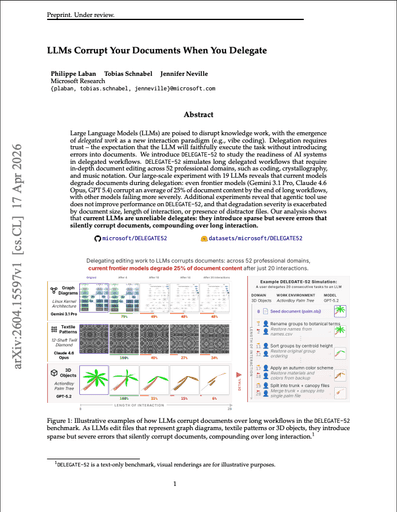
Instead of evaluating a model on one simple task, the authors tested it in a long, multi-step process. Each subsequent task built on the previous results, which made it possible to detect that over time the AI loses and distorts information.
Ask the AI to add data to a table, then in the next message to convert currencies, and finally to remove duplicates. After each of these steps, check to make sure the AI hasn't silently deleted other important columns.

Strategy
Adding "decoys" to tasks (Distractor Environment Setup)
The researchers deliberately added irrelevant but topically similar files to the AI's working environment. The goal was to check whether the model can focus only on the document being edited and not mix up data.
You send the model a new set of rules to fix grammar errors, but as an attachment you also include the old, outdated rules from years ago, to see whether the AI accidentally pastes old provisions from it.
Strategy
Tracking invisible errors (Silent Corruption Tracking)
Models can ruin a file in such a way that at first glance it looks correct, but important pieces of data are missing from it. So special systems were used for constant, line-by-line comparison of file versions.
Using a program for automatic text comparison (a so-called "find the differences" tool) right after the AI hands over the finished file, to catch vanishing words or whole sentences.
Good practice
Short tasks instead of long marathons (Short-horizon Workflows)
Avoid forcing the AI to work continuously on one document in very long conversations. AI errors pile up, and with each further interaction the file gets more and more corrupted.
Instead of writing a whole multi-page report with the AI in one chat window, start a new, clean conversation for each subsequent chapter of the report.
Good practice
A human has to check it (Human Review Validation)
Never trust the results of artificial intelligence's work without limits. Because errors often hide behind a document that looks correct, every change made by the AI needs to be verified.
Paste the text returned by the artificial intelligence into Word or Google Docs with "Track Changes" turned on, so you can manually approve every fragment the model added or removed.
Good practice
Give the AI only what is necessary (Context Size Management)
Don't send the AI whole huge files if it only has to fix one fragment. The more unnecessary text you give the model, the greater the likelihood that it will start losing data.
If you want the model to fix a typo on page 50 of your document, copy and send it only that one short paragraph to fix, instead of uploading the entire hundred-page file.
Avoid
Leaving the AI on its own for a long time (Blind Delegation of Long Workflows)
Don't entrust big editing tasks to artificial intelligence without supervision. Trusting the AI to carry out a long process on files by itself results in leading models irreversibly spoiling as much as 25% of the content.
Sending the instruction: "Translate and format my book", then going out for coffee, assuming that the file you get back when you return will be 100% consistent with the original.
Avoid
Trusting that the AI will check its own mistakes (Over-reliance on Agentic Tools)
Don't think that because the model has access to a calculator or external tools, it will correct its own errors. Research showed that models using these tools does not reduce the number of silent errors in files.
Asking the AI to calculate a budget and reassuring yourself with the thought: "It surely didn't make a mistake, because the model itself wrote that it checked it with a calculator."
Avoid
Judging a book by its cover (Surface-level Trust)
The fact that a file prepared by artificial intelligence opens correctly, looks nice and shows no technical errors does not mean that everything inside the file adds up.
Glancing at a table generated by the model, admiring the nice even columns and sending it straight to the client, without making sure the AI hasn't cut off the last week of data in it.
Strategy
Self-Consistency
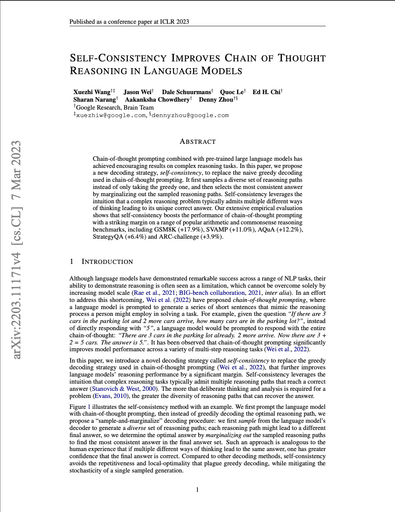
The model generates many different paths leading to a solution and picks the final result by voting for the most frequent answer. This draws on the human intuition that many correct lines of thought should lead to the same conclusion. Explanation or prompt"Generate 5 different ways to solve this math problem, and then give as the final result the one that appears most often."
Self-Consistency Improves Chain of Thought Reasoning in LLMs
Strategy
Greedy Decoding Replacement
Instead of always choosing the "most probable" next word (which promotes formulaic output), the model samples different paths and produces unique analyses of the same problem.
Setting a somewhat higher temperature value in the API and giving the instruction: "Analyze the delivery problem in three completely different ways, generating alternative calculation scenarios."
Strategy
Path Marginalization
A strategy of separating the "thinking process" from the final answer in order to count statistical agreement. The model ignores differences in how it arrived at the result and focuses only on whether the number or fact at the end converges.
"For each of the 3 paths you generated, extract only the final amount to be paid, and then point out the sum that repeats most often."
Good practice
Combining with Chain-of-Thought (CoT Synergy)
The self-consistency method was designed to amplify the power of "step by step" prompting. Always combine the two techniques for the best results. Explanation or prompt"Think about this task step by step. Generate 3 separate step-by-step lines of reasoning for this problem, and at the end choose the common answer by majority vote."
Self-Consistency Improves Chain of Thought Reasoning in LLMsGood practice
Using it for tasks with one specific answer (Fixed-answer tasks)
The technique works best in areas where the final result can be unambiguously extracted and mathematically counted (e.g. math, advanced logic, closed true/false questions). Explanation or promptUsing the instruction "calculate this 5 ways and vote" for a task such as "Calculate the annual VAT for the invoice below", where the answer is a specific number.
Self-Consistency Improves Chain of Thought Reasoning in LLMsGood practice
Scaling the sampling for harder tasks (Scaling samples)
Research shows that the harder and more complex the problem, the more paths you should have the model generate. Generating a dozen or so variants increases the chance of filtering out hallucinations.
"This is a very hard algorithmic problem. Analyze it in 10 independent ways and write out the paths before you finally pick the one correct solution."
Avoid
Excessive use of computational resources (Overcomputing)
Do not ask the model to generate a dozen lines of thought for simple, trivial factual questions. It needlessly burns tokens and your time (and budget).
"Write me 10 different deductive analyses of which country Paris is the capital of, and then choose the answer by vote." (A waste of time for an obvious answer.)
Avoid
Using the technique for open-ended text generation (Open-ended tasks)
Avoid forcing self-consistency on creative writing, generating poems or essays, because there is no consistent, closed solution there for the model to clearly "vote" on.
"Write 5 sci-fi stories, and then pick the one that appears most often as the best." (The task makes no logical sense for this mechanism.)
Avoid
Blind trust in a single path (Single-path reliance)
If the task has a large margin of error inside the AI, avoid relying on the first and only answer the model generates. Greedy algorithms can easily "get stuck" in a bad line of thought.
Asking the model to carry out a multi-step accounting audit with the plain instruction "Solve this task", with a naive belief that an instant, single analysis will be flawless.
Strategy
Using an LLM as a Judge (LLM-as-a-Judge)
The practical use of large language models to automatically evaluate and reward other AI systems in environments where hard, verifiable reference data (ground truth) is lacking.
"Act as an objective judge. Evaluate the answer below, generated by a chatbot, for precision and usefulness, giving it a score on a scale of 1 to 10, and justify your assessment."

Strategy
Implementing the Average Bias-Boundedness (A-BB) framework
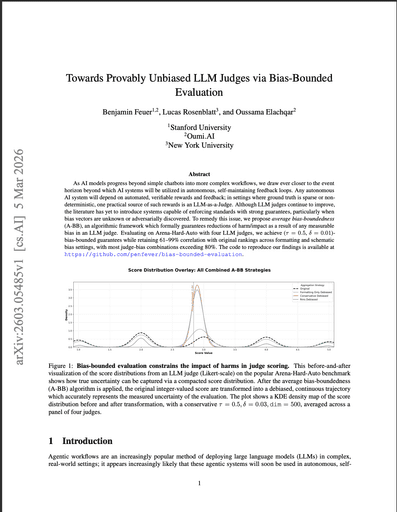
Using mathematical algorithms that formally limit the influence of a model's systematic errors on the final evaluation result. This makes it possible to stay objective even when the causes of the model's biases are complex or unknown.
Imagine that a sports judge always subconsciously favors athletes in red jerseys. This system is a kind of digital filter that automatically notices this error and corrects it, making the scoring fair again.
Strategy
Counteracting uncertainty through controlled noise
A strategy of deliberately and repeatedly introducing small changes to the way questions are asked, in order to rule out random errors during evaluation.
Prompt
Good practice
Measuring the natural variance of scores (Inherent jitter)
Run several evaluation attempts on the same problem before you start making corrections. This will show you whether the AI is just handing out random scores.
Ask the artificial intelligence to evaluate the same text five times in a row. If it gives a completely different result each time (e.g., 2/10 once and 9/10 another time), that is a sign its scores are unstable.
Good practice
Preserving ranking correlation while correcting bias
When fixing the errors of an AI judge, make sure you don't change the actual quality of the programs being evaluated.
When you introduce corrections meant to remove errors in grading, make sure at the end that the student (or program) who objectively wrote the best work still holds first place on the ranking list.
Avoid
Blind trust in autonomous evaluation loops (Blind trust in autonomous loops)
Avoid leaving AI programs to themselves, with one creating content and another approving it, without safety mechanisms in place.
Never let, for example, one bot write emails and another automatically send them to customers based on its own unsupervised judgment. Without oversight, the bots can start accepting gibberish.
Avoid
Ignoring hidden biases
Don't assume a language model is objective just because profanity or racism has been blocked in it. There are errors that are far harder to detect.
You may think that an AI evaluating résumés treats everyone as equal, while the system quietly rejects candidates who didn't use a particular trendy corporate buzzword in their text.
Avoid
Inconsistency between the overall score and the criteria (Schematic adherence bias)
Avoid accepting the AI's final verdicts that have no logical support in its partial scores.
Watch out for situations where the AI gives very poor partial scores (e.g., "very many spelling errors", "no logic"), but at the end, for some reason, issues a final score of 10/10.
Strategy
The Re2 Method (Re-Reading)
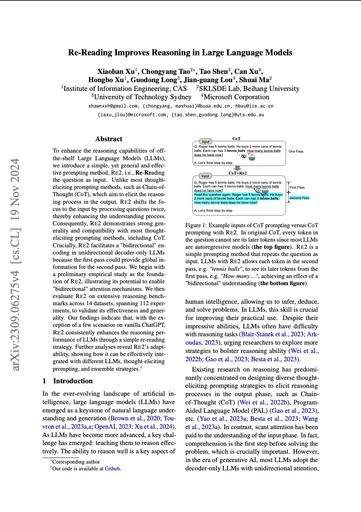
It consists of giving the language model the same question (or problem) twice within a single prompt. This allows deeper processing of the information and imitates the human process of reading a difficult instruction several times before starting to solve it.
"Question: What is 25 * 48? Read the question again: What is 25 * 48? Answer:"

Strategy
Strengthening "Bidirectional" Encoding (Bidirectional Encoding)
Because most LLMs generate text in only one direction (left to right), they don't see the whole context at once at the planning stage. Repeating the question means that on the second read the model already has the general outline of the entire task encoded in its "memory", which improves its performance in the later stages of generating text.
Doubling the question about the key data so that at the end of the query the model has the freshest access to the numbers and conditions it is supposed to refer to in its calculations.
Strategy
Optimal Number of Repetitions (Optimal Repetitions)
The research in the paper indicates that the best results are achieved by reading the problem twice, or three times at most.
Using a block structure in prompts: [Context] -> [Question] -> "Let's read it once more" -> [Question] -> [Generating the solution].
Good practice
Synergy with Chain-of-Thought (CoT Synergy)
The Re2 technique focuses on the input (better understanding of the problem), while CoT focuses on the output (better reasoning). The question-repetition method works excellently when combined with the phrase "think step by step", reinforcing the process at both ends.
"Q: [Difficult engineering task]. Read the question again. Q: [Difficult engineering task]. Let's think step by step."
Good practice
Universality Without Touching the Model (Model-Agnostic)
Because this is pure prompt engineering, you should apply Re2 on every available language model as a quick optimization, without needing costly fine-tuning or updating of the weights.
Implementing the double pasting of the instruction as a standard system template in the code of your own application built on the OpenAI API.
Good practice
Use in Math and Logic Tasks
The technique brings the greatest gains in specific tasks where a precise understanding of the conditions and mathematical symbols decides ultimate success or failure.
Copying and repeating in the prompt a complicated logic puzzle, an intricate description of an IT system, or an equation with many variables.
Avoid
Over-repetition
Avoid pasting the same question four or more times in one query. Research shows this leads to a drop in quality, because the model focuses on the repetition instead of on solving the task, and it also uses up the context window excessively.
"Question: X. Question: X. Question: X. Question: X. Question: X. Give the result." (A mistaken waste of resources that adds noise to the input).
Avoid
Spending tokens on very simple tasks
Since this technique lengthens the prompt and the input cost, avoid using it on trivial questions based on basic knowledge, which the model answers flawlessly the first time.
"What is the fastest land animal? Read again: What is the fastest land animal?" (An unnecessary use of tokens for a very obvious answer).
Avoid
Isolating the technique from other optimizations
Avoid relying solely on the Re-Reading method when solving the hardest problems, forgetting about output formatting. Re2 on its own is only an optimization of the initial understanding of the task, not a comprehensive solution.
Repeating a math question twice in the input, but forcing the model to give an immediate answer containing only a bare number, with no chance for a thought process.
Done!
You went through 44 takeaways.
Keep reading
 Evaluating AGENTS.md: Are Repository-Level Context Files Helpful for Coding Agents?One line of reasoning isn't enough. Make your AI grow branches.
 Tree of Thoughts: Deliberate Problem Solving with Large Language ModelsThere's a way to stop AI making mistakes in simple math. And it isn't retraining the model.
 Chain-of-Thought Prompting Elicits Reasoning in Large Language Models