Takeaways: Re-Reading Improves Reasoning in Large Language Models
Strategy
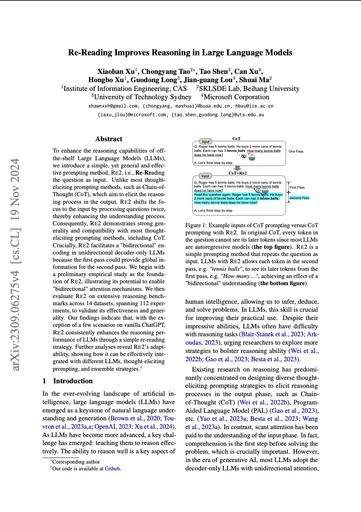
The Re2 Method (Re-Reading)
It consists of giving the language model the same question (or problem) twice within a single prompt. This allows deeper processing of the information and imitates the human process of reading a difficult instruction several times before starting to solve it.
"Question: What is 25 * 48? Read the question again: What is 25 * 48? Answer:"

Strategy
Strengthening "Bidirectional" Encoding (Bidirectional Encoding)
Because most LLMs generate text in only one direction (left to right), they don't see the whole context at once at the planning stage. Repeating the question means that on the second read the model already has the general outline of the entire task encoded in its "memory", which improves its performance in the later stages of generating text.
Doubling the question about the key data so that at the end of the query the model has the freshest access to the numbers and conditions it is supposed to refer to in its calculations.
Strategy
Optimal Number of Repetitions (Optimal Repetitions)
The research in the paper indicates that the best results are achieved by reading the problem twice, or three times at most.
Using a block structure in prompts: [Context] -> [Question] -> "Let's read it once more" -> [Question] -> [Generating the solution].
Good practice
Synergy with Chain-of-Thought (CoT Synergy)
The Re2 technique focuses on the input (better understanding of the problem), while CoT focuses on the output (better reasoning). The question-repetition method works excellently when combined with the phrase "think step by step", reinforcing the process at both ends.
"Q: [Difficult engineering task]. Read the question again. Q: [Difficult engineering task]. Let's think step by step."
Good practice
Universality Without Touching the Model (Model-Agnostic)
Because this is pure prompt engineering, you should apply Re2 on every available language model as a quick optimization, without needing costly fine-tuning or updating of the weights.
Implementing the double pasting of the instruction as a standard system template in the code of your own application built on the OpenAI API.
Good practice
Use in Math and Logic Tasks
The technique brings the greatest gains in specific tasks where a precise understanding of the conditions and mathematical symbols decides ultimate success or failure.
Copying and repeating in the prompt a complicated logic puzzle, an intricate description of an IT system, or an equation with many variables.
Avoid
Over-repetition
Avoid pasting the same question four or more times in one query. Research shows this leads to a drop in quality, because the model focuses on the repetition instead of on solving the task, and it also uses up the context window excessively.
"Question: X. Question: X. Question: X. Question: X. Question: X. Give the result." (A mistaken waste of resources that adds noise to the input).
Avoid
Spending tokens on very simple tasks
Since this technique lengthens the prompt and the input cost, avoid using it on trivial questions based on basic knowledge, which the model answers flawlessly the first time.
"What is the fastest land animal? Read again: What is the fastest land animal?" (An unnecessary use of tokens for a very obvious answer).
Avoid
Isolating the technique from other optimizations
Avoid relying solely on the Re-Reading method when solving the hardest problems, forgetting about output formatting. Re2 on its own is only an optimization of the initial understanding of the task, not a comprehensive solution.
Repeating a math question twice in the input, but forcing the model to give an immediate answer containing only a bare number, with no chance for a thought process.
Done!
You went through 9 takeaways.
Keep reading
 Chain-of-Thought Prompting Elicits Reasoning in Large Language ModelsDon't trust the first answer. Hold a vote.
 Self-Consistency Improves Chain of Thought Reasoning in LLMsA short phrase instead of worked examples
 Large Language Models are Zero-Shot Reasoners