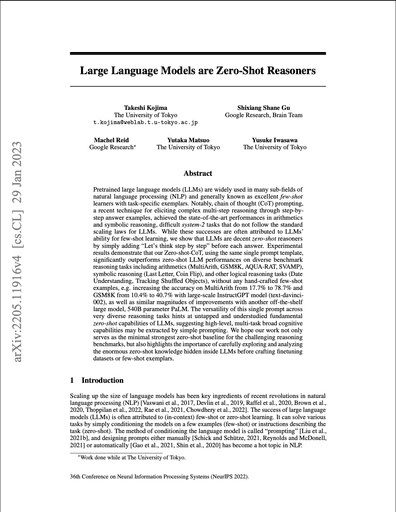
Takeaways: Large Language Models are Zero-Shot Reasoners
Strategy
Zero-Shot Chain of Thought (Zero-Shot-CoT)
A strategy showing that the model does not need ready-made examples of how to solve a task (few-shot). To activate logical reasoning and avoid mistakes in complex tasks, it is enough to encourage the model to break the process into steps using a so-called trigger phrase.
"Calculate how many apples Tom has if he started with 15, ate 3, and then bought twice as many as he had left. Let's think about it step by step."

Strategy
Two-Stage Prompting
A process that logically separates the thinking stage from the stage of producing the result. In the first stage the model generates an analysis, and in the second the system makes it extract just the answer, which is crucial for automating tasks.
"Given the reasoning above, the final answer (written in digits only) is:"
Strategy
Latent Knowledge Extraction
The report shows that giant language models have deep knowledge and reasoning abilities. The strategy is to test unlocking them with zero-shot mode before a developer resorts to costly "retraining" of the model (fine-tuning).
"Before you give me the solution, break this problem down into smaller parts and explain your thought process step by step."
Good practice
Use a single, universal template (Single Prompt Template)
The report shows that using one general trigger phrase, "Let's think step by step," for different types of tasks (math, logic, word games) gives great results without having to tailor the prompt to a specific problem.
"Task: [any description of a hard engineering problem]. Let's think step by step."
Good practice
Build a simple baseline (Minimal Baseline)
Always start testing a model's performance with the Zero-Shot-CoT technique. It often gives very strong, satisfying results, so you avoid unnecessary, manual crafting of many examples in the prompt.
"Is the statement 'Every triangle is a square' true? Let's first analyze it step by step."
Good practice
Separate the line of reasoning from the answer
Always make the model show its path of deduction. This not only improves the correctness of the model's answer, but also makes debugging easier and helps you pinpoint where the AI went wrong.
"Think step by step out loud. At the very end, on a separate line, write 'RESULT: [your final answer]'."
Avoid
Forcing direct answers to complex problems (Direct Answer Prompting)
Avoid giving hard tasks while demanding the result immediately. Without a built-in thinking process, the model often produces wrong guesses.
"Solve this task: 42 * 13 / 2 and give me only the final result immediately."
Avoid
Relying too quickly on "Few-Shot Prompting"
Avoid investing time in crafting special examples inside prompts before you have tried Zero-Shot-CoT mode. Research shows that models do worse with a few poorly chosen examples than with a single "step by step" instruction.
Manually adding 3 different logic tasks with solutions to the prompt, when simply this would work: "Think step by step."
Avoid
Overloading the instructions that trigger reasoning
Overly detailed instructions about how the model should think can make the AI get lost in following them instead of actually solving the task.
"Generate a chain of thought that contains at least 5 paragraphs of deduction, each describing one variable and then leading to a verdict."
Done!
You went through 9 takeaways.
Keep reading
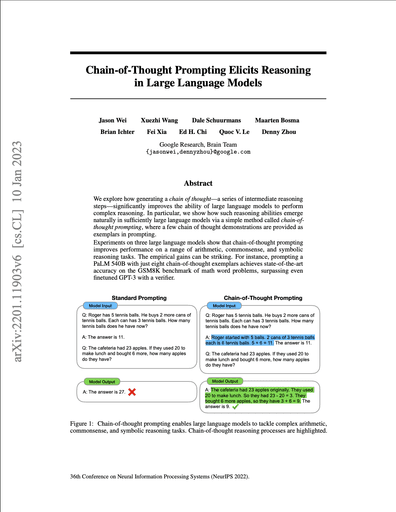
 Chain-of-Thought Prompting Elicits Reasoning in Large Language ModelsHard question? Ask a broader one first.
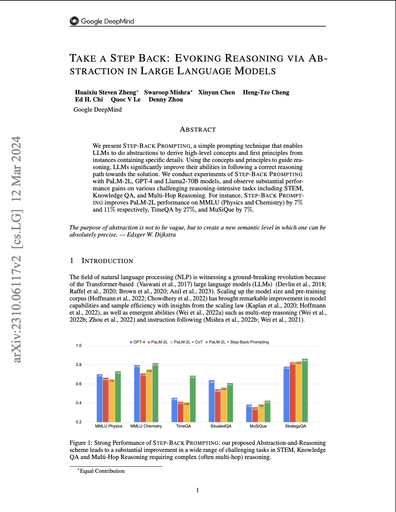
 Take a Step Back: Evoking Reasoning via Abstraction in Large Language ModelsPaste the same question twice. It's not a mistake.
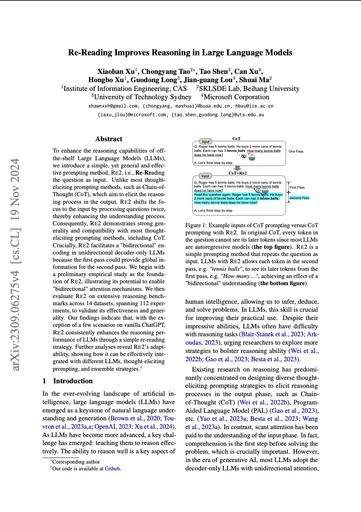
 Re-Reading Improves Reasoning in Large Language Models