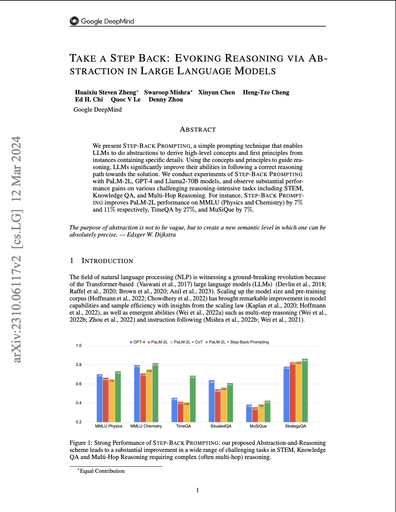
Takeaways: Take a Step Back: Evoking Reasoning via Abstraction in Large Language Models
Strategy
Step-Back Prompting (Abstraction before reasoning)
A technique in which you get the model to "take a step back" and generate a broader, more general question from a detailed problem, in order to recall physical or historical principles or high-level concepts (first principles).
"Instead of answering the question 'What was the pressure of a gas at a temperature of 50 degrees and a volume of 20 liters?' right away, first ask: 'What universal physical law links the temperature, volume and pressure of a gas?'"

Strategy
Two-step process (Abstraction-and-Reasoning)
A strategy that splits the problem-solving process into two distinct stages: first the model generates an abstract concept, time frame or principle for the given task, and only in the second step does it use this recalled background knowledge to carry out the final deduction.
"Step 1: List the general principles of Newton's laws of motion. Step 2: Using the principles you listed, calculate the force with which the two specific vehicles from the task collided."
Strategy
Grounding reasoning in fundamental laws
Forcing the model to explicitly state and explain definitions, laws or formulas before attempting any mathematical or logical calculation, to guard against errors in the intermediate steps (so-called Math/Reasoning Errors).
"Define exactly what operating profit is and what elements it consists of according to accounting standards, and then, based on that clean definition, calculate it for company X from the data below."
Good practice
Using "step back" helper questions in QA
For questions about a very specific time frame or a narrow historical context, it is worth first asking the model to generate a general biography or outline of the history, from which the model itself can then safely pull the details you want.
"Problem: 'Which school did Estella attend in August 1954?'. Instead of asking directly, use the prompt: 'Write a general education history of Estella, and then, on that broad basis, determine exactly where she was in August 1954.'"
Good practice
Combining abstraction with In-Context Learning (Few-Shot)
Models do best with the Step-Back technique when the prompt shows them a few reference examples of how to correctly extract "high-level principles" from various, random tasks, before you ask them to solve the target.
"Example 1: If the question is about a car's speed, the right abstraction is the formula V=s/t. Example 2: If the question is about fuel combustion, the abstraction is the law of conservation of mass. Now look at my question about a rocket flight, give the right abstraction and only then solve the problem based on it."
Good practice
Using abstraction to improve RAG (Retrieval-Augmented Generation)
"Step back" questions work great for searching external databases. Broader, abstract queries often return more relevant and context-rich source documents than highly detailed questions.
"Before you tell the model to search the company's document base for the answer to the very narrow query 'What was the second installment of John Smith's mortgage in March 2021?', tell it to search for 'John Smith's loan agreement and full repayment schedule'."
Avoid
Hitting highly detailed problems head-on (Direct Prompting for constraints)
Trying to get a direct answer from the model to questions tightly constrained by specific conditions (e.g. a particular month and fraction of a second in history) often results in made-up facts (hallucinations), because the model loses the broader picture of the situation.
"Tell me exactly what the president was doing on March 14, 2005 at 3:00 p.m., without laying out a broader timeline of his presidency around that date."
Avoid
Solving STEM tasks without recalling the theory
Requiring the model to immediately perform multi-step physics or chemistry calculations, without first defining the laws governing the given phenomenon. This almost always leads to errors in assigning variables and in the final result.
"Solve this long thermodynamics problem with many variables and give me just the final result, without wasting time writing out the laws of physics and formulas."
Avoid
Blind trust in invisible thought processes
Avoid letting the model hide the step where it creates definitions. If the model defines the base principle wrongly (a so-called Principle Error), all of the reasoning that follows will be useless. Always force the definitions to be written out in the text so you can verify them.
"Apply a physical principle hidden in the background and give me the answer to my problem right away, without showing me in the text which principle you assumed in your first step."
Done!
You went through 9 takeaways.
Keep reading
 Large Language Models are Zero-Shot ReasonersOne line of reasoning isn't enough. Make your AI grow branches.
 Tree of Thoughts: Deliberate Problem Solving with Large Language ModelsThere's a way to stop AI making mistakes in simple math. And it isn't retraining the model.
 Chain-of-Thought Prompting Elicits Reasoning in Large Language Models