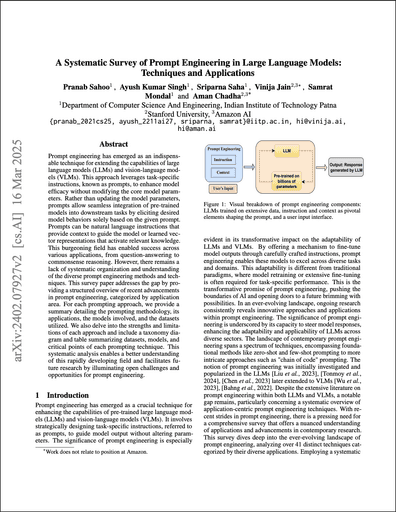
Takeaways: A Systematic Survey of Prompt Engineering in Large Language Models: Techniques and Applications
Strategy
Zero-Shot Prompting
A technique that relies solely on the built-in knowledge of a pre-trained model, without giving it any ready-made examples of a solution. It works great for simple, common tasks, where the AI can naturally generalize concepts from its training data.
"Classify this article as 'Sports' or 'Politics': 'Real Madrid won yesterday's Champions League match 3-1.'"

Strategy
Few-Shot Prompting
A strategy of giving the model a few example "input-output" pairs in the prompt itself before asking the actual question. This lets the AI imitate the expected pattern (meta-learning) and significantly improves accuracy on non-standard tasks.
"Review: 'Great movie!' -> Positive. Review: 'Boring and a waste of time.' -> Negative. Review: 'The acting was fine, but the plot was weak.' ->"
Strategy
Chain-of-Thought (CoT) Prompting
An advanced technique that makes the model generate intermediate reasoning steps before it gives the final result. It simulates the human step-by-step analytical process, dramatically improving performance on hard logic and arithmetic problems.
"Before you give the final result, write out your reasoning step by step to calculate Anna's age, assuming she is twice as old as her 10-year-old brother, and in 5 years he will be..."
Good practice
Building strong, detailed context
The more precise background information (the model's role, the business goal, the target audience) you put in the instruction, the more accurate the generated content becomes and the less prone to vague answers (so-called hallucinations).
"You are a senior SEO expert at a marketing agency. Your task is to create a list of 5 long-tail keywords for a local coffee shop in Łódź, aimed at students looking for a place to study."
Good practice
Precisely formatting the output
Always state clearly what structure you want the answer in (e.g. a table, JSON, a specific number of paragraphs, a bulleted list). This saves the user the time of manually reformatting the data afterward.
A practical example that shows the idea in a simple way (a prompt or a short description): "Analyze the text below and return the 3 most important conclusions. Present them as a table with two columns: 'Conclusion' and 'Quote from the text supporting the conclusion'."
Good practice
Iterative refinement
Writing prompts is rarely a one-shot process. Watching the model's mistakes and fixing your queries with additional constraints lets you systematically "calibrate" the final result over a series of conversations with the assistant.
"The text above is good, but its tone is too scientific. Now modify it so that it is understandable to an elementary school student, while keeping all the key facts."
Avoid
Using ambiguous or very vague language
Prompts that leave a lot of room for interpretation force the model to "guess" your intentions. This often leads to answers that are technically correct but useless from the user's perspective.
"Write me something interesting about computers and why they are important."
Avoid
Overloading the context window (Context Overload) in the Few-Shot method
Avoid inserting too many lengthy examples to teach the model. They take up precious "tokens" of the LLM's limited working memory, raise the cost of generation, and can make the AI ignore key instructions at the very bottom of the prompt.
Pasting 20 pages of technical documentation with examples just to ask the model, in the end, a simple question about how to correctly close a given tag in HTML code.
Avoid
Mixing roles and contradictory instructions
Introducing many unrelated formatting rules, or clashing roles to play, in one small block of text can overwhelm the model, causing it to lose key points of the task.
"Be a 19th-century math professor, but use modern Gen-Z slang. Your answer must be exactly 40 words long, written in hexameter, and include a financial analysis of my company."
Done!
You went through 9 takeaways.
Keep reading
 Chain-of-Thought Prompting Elicits Reasoning in Large Language ModelsIs your prompt a single sentence? Break it into sections.
 Prompt Engineering and the Effectiveness of Large Language Models in Enhancing Human ProductivityBefore you talk prompts, agree on what the words mean
 The Prompt Report: A Systematic Survey of Prompt Engineering Techniques