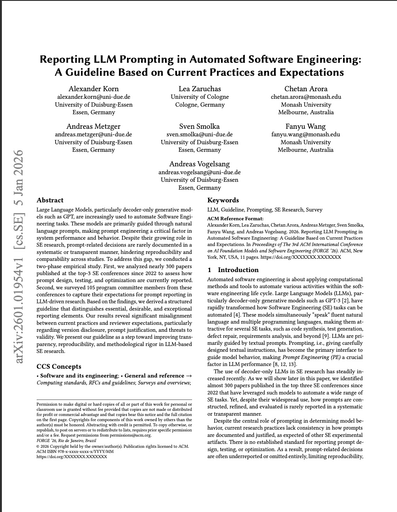
Takeaways: Reporting LLM Prompting in Automated Software Engineering: A Guideline Based on Current Practices and Expectations
Strategy
Reporting Elements Categorization (Reporting Elements Categorization)
Separating information about prompts in studies into essential, desirable and exceptional, which lets developers and researchers match the level of detail in their documentation to commonly expected standards.
Including the full prompt text and the exact model name in the documentation as "essential" information, and the possible history of trial and error from optimizing the query as "desirable" information.

Strategy
Disclosing full version data (Version Disclosure)
Clearly stating the exact model versions, access dates and parameter settings, which is crucial for other engineers being able to repeat (reproduce) the tests.
"we used the GPT-4 model", we report: "Model: GPT-4-0613, Temperature: 0.2, Top-p: 0.9, test date: October 15, 2025".
Strategy
Prompt Justification (Prompt Justification)
A requirement to describe explicitly why a given prompt has the structure it has, and which specific methods or keywords were deliberately used in it.
"The zero-shot chain-of-thought technique ('Think step by step') was used because earlier tests showed that without it the model gets lost when analyzing complex Java code."
Good practice
Systematic Documentation of prompt engineering (Systematic Documentation)
Maintaining a detailed, publicly available research repository (e.g. on GitHub) containing the final prompts, configuration files and the collected outputs of the artificial intelligence.
Making available a README.md file in a public research repository that links to all 150 prompts used in the experiment, together with the scripts that automated sending them.
Good practice
Explicit reporting of threats to validity (Threats to Validity Reporting)
Treating the instability of generated answers and the phenomenon of LLM "hallucinations" as built-in flaws of the research, and describing in the documentation, as a requirement, how the researchers controlled this risk.
Adding a point to the documentation: "Because the model could have made up API calls in the generated code, every generated snippet underwent a rigorous automated test compilation in a safe environment before the result went into the final statistics of the study."
Good practice
Optimization Transparency (Optimization Transparency)
Describing accurately and transparently in papers the process of improving queries: whether it was done manually by trial and error, or whether other, automated frameworks were used for it.
"The initial prompt was written manually by the researcher and then optimized iteratively with the DSPy tool, which ultimately increased the correctness of the studied code syntax by 24%."
Avoid
Omission of Prompt Context (Omission of Prompt Context)
Avoid presenting in studies only fragmentary descriptions of queries without the full context or the underlying system instruction, which makes it completely impossible for others to repeat your tests and assess their reliability.
"We asked ChatGPT to generate unit tests." instead of presenting in an appendix the precise step-by-step instruction that was used in the API.
Avoid
Ignoring Model Drift (Ignoring Model Drift)
Avoid assuming in publications that models offered from the cloud, and their hidden updates, will always work equally well on the same prompt. It is essential to record the specific date the tests were run.
Avoid publishing results suggesting that a prompt's effectiveness on a public API is "always 90%" without giving the exact date. After a silent update on the provider's servers, the same prompt may soon work completely differently.
Avoid
Omitting negative results in experiments (Hiding Failed Prompts)
Don't hide the lines of reasoning and prompt variants that simply didn't work after testing on code. Documenting failed queries is just as valuable to the community as the final engineering successes.
Presenting in a scientific publication only one "perfect" query, suggesting that the engineer came up with it on the first try, while the team quietly discarded 20 failed variants, which would also be worth writing about to warn others.
Done!
You went through 9 takeaways.
Keep reading
 Which Prompting Technique Should I Use? An Empirical Investigation of Prompting Techniques for Software Engineering TasksMore instructions for your agent, worse results? Measure it.
 Evaluating AGENTS.md: Are Repository-Level Context Files Helpful for Coding Agents?One task went fine. The trouble shows up after many more.
 LLMs Corrupt Your Documents When You Delegate