Takeaways: From Scale to Speed: Adaptive Test-Time Scaling for Image Editing
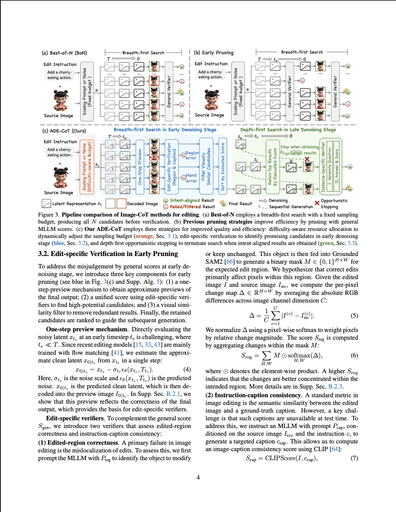
Strategy
Dynamic resource allocation depending on difficulty (Difficulty-aware Resource Allocation)
The mechanism can estimate how complicated a request to modify an image is and automatically picks an appropriate "budget" of computing time, saving it on simple tasks.
From Scale to Speed: Adaptive Test-Time Scaling for Image Editing
Strategy
Focusing verification on details (Edit-specific Verification)
In the early phase, the system rejects failed image variants by analyzing only the specific area that was supposed to change, ignoring the overall visual appeal of the whole file.
From Scale to Speed: Adaptive Test-Time Scaling for Image EditingStrategy
Opportunistic Stopping (Opportunistic Stopping)
The process intelligently halts further image generation as soon as it comes across a version that meets the given criteria, eliminating the need to excessively create dozens of variants.
"Instead of making the model mindlessly generate 50 versions of a graphic blindly, the system devotes a lot of time only to difficult cutouts (e.g. changing a forest background to a city), spot-checks the results after a few attempts and stops right away when the result is correct – saving half of the waiting time."
Good practice
Optimizing the performance-efficiency balance
Instead of relying on the traditional "generate n images and pick the best one" method (Best-of-N), it is worth using spot verification during the process.
From Scale to Speed: Adaptive Test-Time Scaling for Image EditingGood practice
Treating editing as a process with strong constraints
Remember that making corrections to photos is not the same as generating from scratch. Evaluation of the model's work should be built so that it forces the model to rigorously preserve the untouched rest of the original image.
From Scale to Speed: Adaptive Test-Time Scaling for Image EditingGood practice
Using text-visual consistency
The best indicator of a successful edit is confirming whether the small edited part of the frame perfectly matches the adjectives and nouns used in the prompt.
"Instruction for the verifying model: Analyze only the top right corner of the submitted photo of a room. Does the newly inserted object there unambiguously match the description 'old, wooden dresser'? If not, immediately reject this version."
Avoid
Blindly mapping standard Image-CoT (Text-to-Image) onto editing
Tools designed to force long chains of reasoning and generation in Text-to-Image models don't work well for modifying existing photos, causing the user's intent to be missed.
From Scale to Speed: Adaptive Test-Time Scaling for Image EditingAvoid
Fixed sampling budgets for every task
Giving every editing task the same power and number of steps is a waste of resources – a slight change of brightness doesn't need as much computation as swapping a person in the frame.
From Scale to Speed: Adaptive Test-Time Scaling for Image EditingAvoid
Judging edits with general visual scores (General MLLM scores)
Avoid using general "aesthetic scores" or broad visual ratings when rejecting early versions of an image.
"Never have the system remove variants just because the artificial intelligence model judged them 'less aesthetic', when all that was requested was a simple change of a blouse's color. Evaluate only the execution of the requested change, not the artistic composition of the whole photo."
Done!
You went through 9 takeaways.
Keep reading
 Efficient Prompting Methods for Large Language Models: A SurveyThere's a way to stop AI making mistakes in simple math. And it isn't retraining the model.
 Chain-of-Thought Prompting Elicits Reasoning in Large Language ModelsA Polish 11B model in about 3 GB. Yes, it can shrink that far.
 Bielik-Q2-Sharp: A Comparative Study of Extreme 2-bit Quantization Methods for a Polish 11B Language Model